
POPIA compliance managed by evidence, not assumption.
XGRC® gives Information Officers a structured way to manage POPIA obligations on one auditable platform, including processing conditions, data subject rights, and security compromise reporting to the Information Regulator.
Unstructured POPIA compliance leaves the Information Officer exposed.
When processing records, consent, and security compromise response are not centrally managed, the Information Officer cannot demonstrate that the organisation meets its POPIA obligations — until the Information Regulator asks.
-
No documented process supporting the Information Officer's statutory duties
-
Processing conditions and lawful justification not consistently recorded
-
Data subject access and correction requests handled inconsistently
-
No structured process for assessing and reporting a security compromise to the Information Regulator
A structured, repeatable data protection process.
- 01
Formalise the Information Officer role and reporting structure
- 02
Maintain a record of processing activities and lawful justification
- 03
Apply minimality and purpose limitation to new processing activities
- 04
Manage data subject access, correction, and objection requests to a defined process
- 05
Assess and report security compromises through a structured workflow
- 06
Report POPIA compliance posture and open risks to management
Built for Information Officers, visible to leadership.
- Central register of processing activities and lawful justification
- Structured data subject request intake and tracking
- Operator and third-party agreement tracking
- Security compromise workflow with Information Regulator notification steps
- Real-time dashboards and compliance reporting
 MSXCyber®
One connected view of data protection
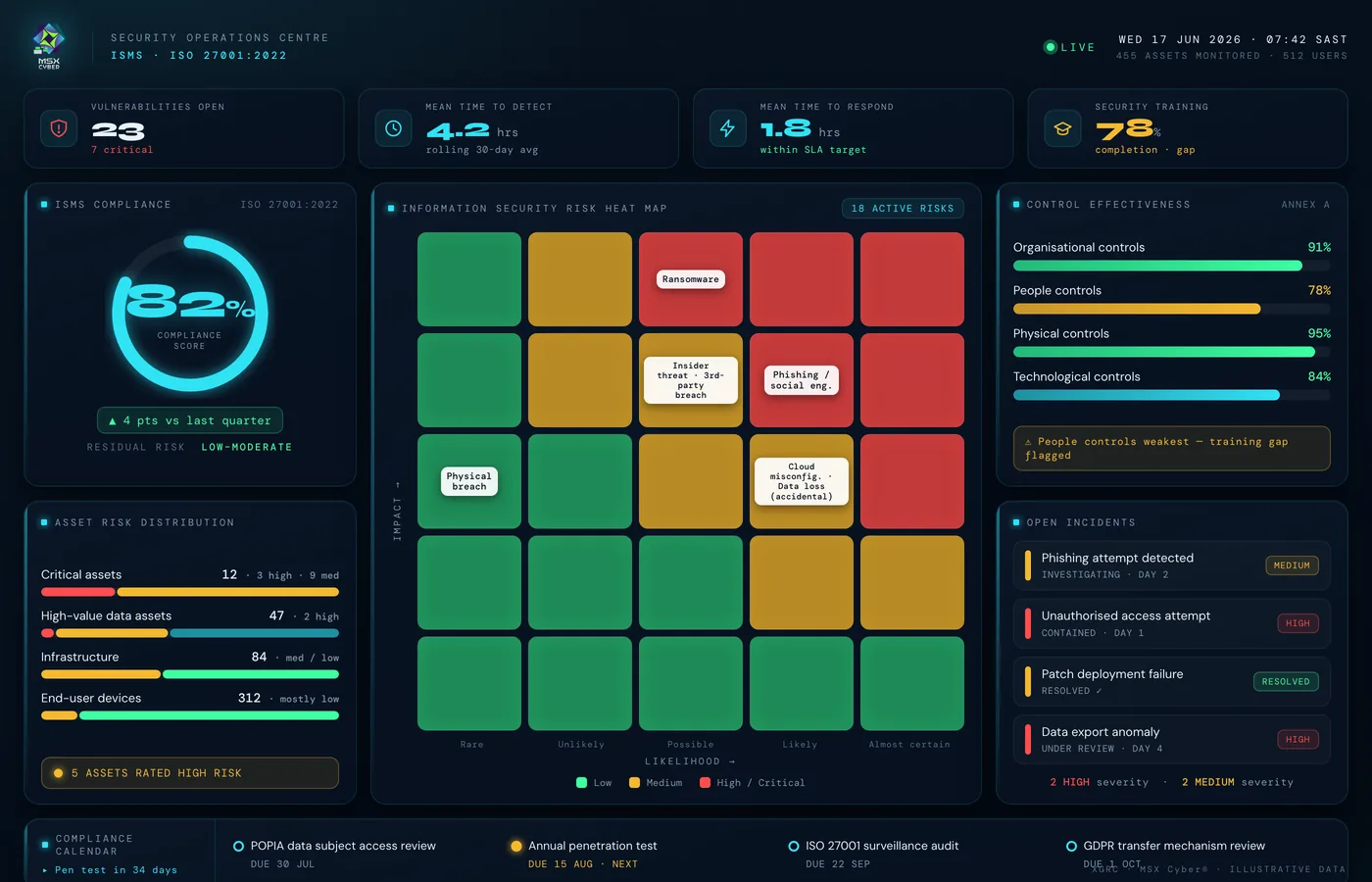
MSXCyber® gives the Information Officer a single place to manage processing records, data subject requests, and security compromise response, linked to the same risk and governance framework used across the organisation's ISMS.
The same POPIA process, without the guesswork.
Manual approach: Processing conditions undocumented
XGRC® approach: Centralised, current processing register
Manual approach: Data subject requests tracked by email
XGRC® approach: Structured request intake and tracking
Manual approach: No consistent security compromise process
XGRC® approach: Documented security compromise workflow
Manual approach: Information Officer duties informal
XGRC® approach: Formalised Information Officer oversight
POPIA Readiness & Compliance Checklist
- Information Officer governance
- Processing conditions and lawful justification
- Data subject rights handling
- Security safeguards
- Security compromise management
- Cross-border transfer safeguards
Explore the connected platform.
Solution MSXCyber®
Information Security Governance
Explore MSXCyber® → Regulatory GDPR Compliance
XGRC® gives data protection teams a structured way to manage GDPR obligations — lawful basis and consent, data subject requests, DPIAs, and breach notification — on one auditable platform, with every processing activity linked to its evidence.
View use case → Regulatory
PAIA Compliance
XGRC® gives organisations a structured way to manage PAIA obligations — the published information manual, records classification, and formal access requests — from intake through decision and response, on one auditable platform.
View use case → Use Case Compliance Management
XGRC Compliance Hub enables organisations to manage supplier, contractor, and customer compliance through a structured portal. External parties upload and maintain their own documentation while internal teams validate, approve, and monitor compliance status in real time.
View use case →Common questions.
01What is POPIA compliance software?
POPIA compliance software gives the Information Officer a structured way to manage processing conditions, data subject rights and security compromise reporting on one auditable platform, rather than relying on informal, undocumented practice.
02Does XGRC® support the Information Officer’s statutory duties directly?
Yes. The platform formalises the Information Officer role and reporting structure, and gives them a central place to manage processing records, requests and compromise response.
03How are security compromises reported to the Information Regulator?
Security compromises go through a structured workflow with defined Information Regulator notification steps, so the assessment and reporting process is consistent rather than improvised under pressure.
04Does this cover operator and third-party agreements?
Yes. Operator and third-party agreement tracking is part of the platform, so data shared with processors is covered by the same oversight as data processed internally.
See POPIA compliance as a structured, auditable process.
Book a demo to see how XGRC® brings processing records, data subject requests, and security compromise reporting into one connected platform.
Where should we send your download link?
Enter your details and we will email you the link to the checklist.
Your checklist is ready.
Click the button below to download the PDF. We have also sent this link to your email.
Download the checklist (PDF)