
PAIA requests managed through a structured process, not an inbox.
XGRC® gives organisations a structured way to manage PAIA obligations — the published information manual, records classification, and formal access requests — from intake through decision and response, on one auditable platform.
Unstructured request handling creates compliance and reputational risk.
When formal information requests are tracked by email with no central log, organisations cannot show a requester — or the Information Regulator — that requests were handled consistently and on time.
-
PAIA manual outdated or not aligned to the records actually held
-
Formal access requests received and tracked through email
-
No consistent process for assessing statutory grounds for refusal
-
No audit trail linking a request to its decision and response
A structured, repeatable request-handling process.
- 01
Compile and publish a current PAIA manual
- 02
Classify records held by category and sensitivity
- 03
Log every formal request received, with requester and record details
- 04
Assess each request against statutory grounds for access or refusal
- 05
Track decisions, fees, and responses to a defined process
- 06
Report request volumes, timelines, and outcomes to management
Built for information officers, visible to compliance teams.
- Central log of every formal access request received
- Structured records classification aligned to the PAIA manual
- Configurable request assessment and decision workflow
- Appeal and escalation tracking
- Real-time dashboards and reporting on request handling
 XGRC® Compliance Hub
One connected view of information requests
XGRC Compliance Hub gives information officers a single place to log, assess, and respond to formal access requests, with a complete audit trail from receipt to closure — replacing the email trail that makes PAIA compliance difficult to demonstrate.
The same PAIA process, without the administrative risk.
Manual approach: Requests tracked in email
XGRC® approach: Centralised request log and audit trail
Manual approach: Manual, inconsistent decision-making
XGRC® approach: Structured, consistent decision workflow
Manual approach: No audit trail of decisions
XGRC® approach: Full record of decisions and correspondence
Manual approach: Outdated PAIA manual
XGRC® approach: PAIA manual aligned to records actually held
PAIA Readiness & Compliance Checklist
- PAIA manual and governance
- Records classification and management
- Request intake and logging
- Request assessment and response
- Appeals and escalations
- Reporting and audit trail
Explore the connected platform.
Solution XGRC® Compliance Hub
Supplier & Third-Party Compliance
Explore XGRC® Compliance Hub → Regulatory
POPIA Compliance
XGRC® gives Information Officers a structured way to manage POPIA obligations on one auditable platform, including processing conditions, data subject rights, and security compromise reporting to the Information Regulator.
View use case → Use Case Compliance Management
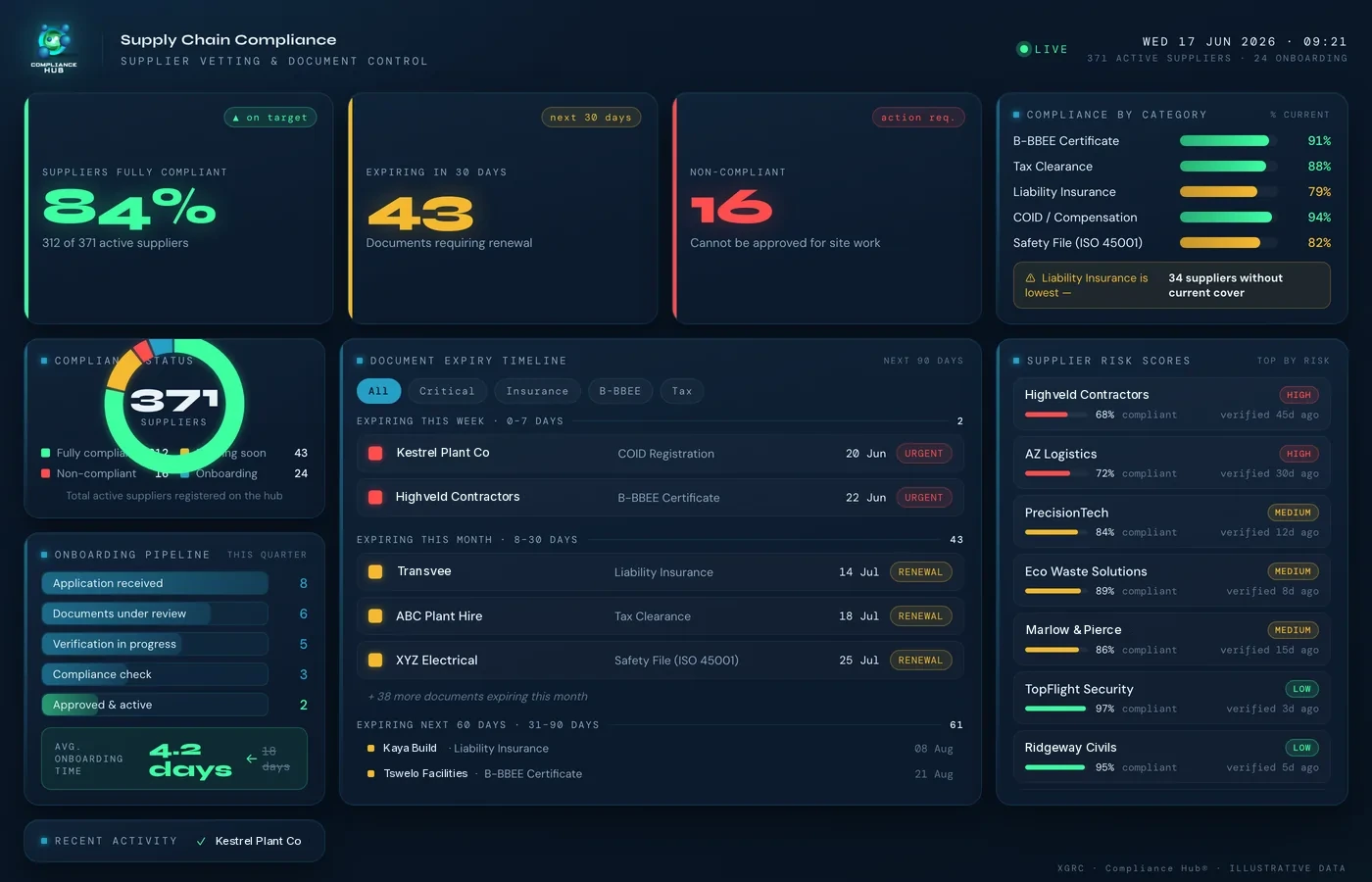
XGRC Compliance Hub enables organisations to manage supplier, contractor, and customer compliance through a structured portal. External parties upload and maintain their own documentation while internal teams validate, approve, and monitor compliance status in real time.
View use case → Use Case Vendor Management
XGRC® enables organisations to onboard, vet, and monitor suppliers and contractors through a structured process. Every vendor document, expiry date, and risk score is tracked in one place, so third-party compliance status is always known.
View use case →Common questions.
01What is PAIA compliance software?
PAIA compliance software manages the published information manual, records classification and formal access requests from intake through decision and response, on one auditable platform rather than an inbox.
02Does XGRC® keep an audit trail of access request decisions?
Yes. Every request is logged with a complete audit trail from receipt to closure, so a decision can be explained and defended to a requester or the Information Regulator.
03How are requests assessed against statutory grounds for refusal?
Requests go through a configurable assessment and decision workflow aligned to statutory grounds for access or refusal, so assessments are applied consistently rather than case by case.
04Does this cover appeals and escalations?
Yes. Appeal and escalation tracking is part of the same workflow, so a disputed decision is not handled outside the system that logged the original request.
See PAIA compliance as a structured, auditable process.
Book a demo to see how XGRC Compliance Hub brings information requests, decisions, and audit trail into one connected platform.
Where should we send your download link?
Enter your details and we will email you the link to the checklist.
Your checklist is ready.
Click the button below to download the PDF. We have also sent this link to your email.
Download the checklist (PDF)