
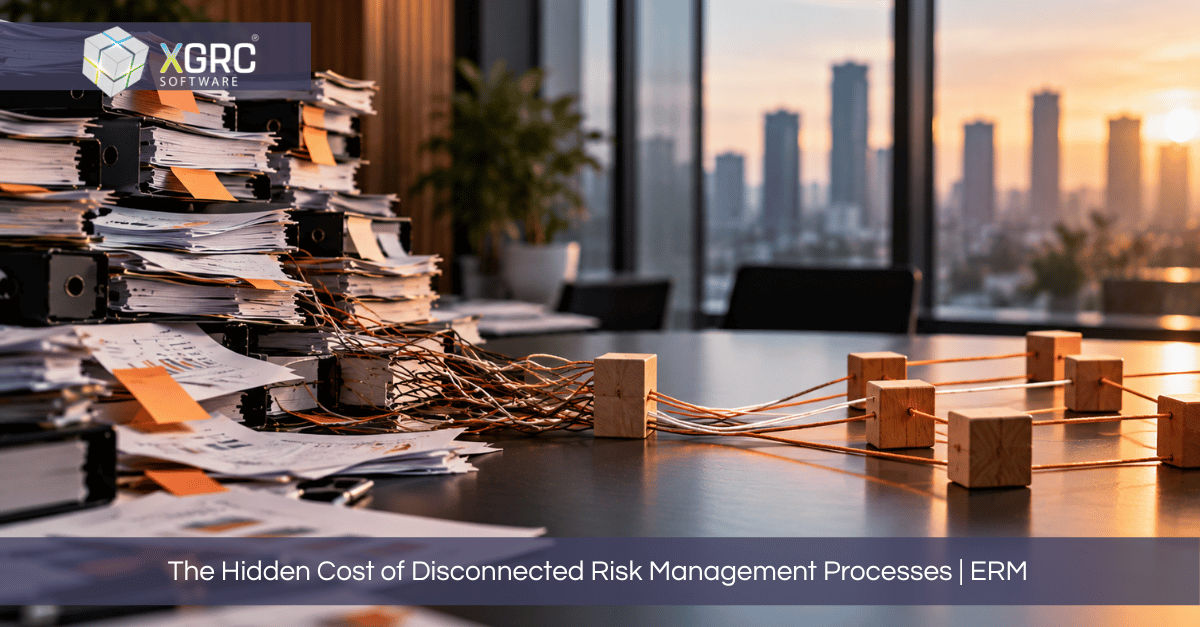
Most organisations do not lack risk management. They have a finance risk register, an operational risk register per site, an IT risk log, a compliance risk matrix and a project risk sheet for every major capital project. The trouble is that these rarely talk to each other, and the cost of that silence never appears as a line item.
What Is Integrated Risk Management?
Integrated risk management is the practice of assessing, treating and reporting all of an organisation's risks with one method, one set of rating criteria and linked records, so that related exposures, controls, incidents and actions can be seen together. It turns many departmental registers into one enterprise view without removing local ownership.
That definition matters because the problem is rarely a shortage of effort. It is effort spent in parallel, on overlapping information, by people who cannot see each other's work. Below are the four hidden costs we see most often, and what to do about each.
Hidden Cost One Duplicated Effort
When five functions maintain five registers, the same risk is often identified, assessed and reported several times under different names. "Loss of key supplier" in procurement, "production interruption" in operations and "revenue shortfall" in finance may all describe one dependency. Each is rated differently, reviewed on a different cycle and treated with different actions.
The direct cost is the time spent maintaining and then reconciling these records before every risk committee. The less visible cost is that the people closest to the risks spend their energy on administration rather than on improving controls. We compared this pattern with dedicated tooling in ERM software versus traditional risk tools.
Hidden Cost Two Late Escalation
In disconnected setups, risk information travels upwards on a fixed reporting calendar. A deteriorating key risk indicator in March might reach the executive committee in June, after it has been rolled into a departmental summary and re-rated by someone who was not close to the facts.
Late escalation is expensive because options narrow over time. A supplier showing early signs of financial distress can be managed with dual sourcing or buffer stock if you know in March. By June the only option may be emergency procurement at a premium. Integrated records let thresholds trigger escalation when they are breached, not when the next meeting comes round.
Hidden Cost Three Untreated Interdependencies
The most damaging cost is the risk that falls between registers. Consider a South African manufacturer whose plant relies on a single water treatment contractor. Operations rate contractor failure as moderate because there is a contract with penalties. Environmental rates a discharge exceedance as moderate because monitoring is in place. Legal rates a breach of the water use licence as moderate because there has been none. Each assessment is reasonable in isolation.
Together they describe one failure that could halt production, trigger regulatory action and damage community relationships at the same time. No single register shows that combined exposure, so nobody owns it and nobody treats it. ISO 31000 describes risk as the effect of uncertainty on objectives, and objectives are shared across functions even when registers are not. Our article on the hidden cost of management system silos explores how the same pattern plays out in SHEQ and quality systems.
Hidden Cost Four Board Blind Spots
Boards and risk committees see what reaches them. When the enterprise view is assembled by hand from departmental summaries, two distortions creep in. Ratings are averaged or softened as they move up, and risks that do not fit any department's template drop out. The result is a board pack that is tidy but incomplete, and a board that believes it has oversight it does not have.
For South African boards applying the King Code, this is not a theoretical concern. The governing body is expected to oversee risk and to rely on combined assurance, and both depend on knowing which risks exist and how well they are controlled.
How to Move Towards Integrated Risk Management
The shift does not require a big-bang project. These steps can be taken over two or three reporting cycles.
- Agree one risk taxonomy and one rating scale for likelihood and impact, with impact criteria defined in business terms such as financial loss, harm, regulatory consequence and reputation.
- Consolidate the registers into one structure, keeping local owners and local views, and merge duplicate risks that describe the same exposure.
- Link each risk to its controls, related incidents, audit findings and treatment actions, so that changes in any of them are visible on the risk itself.
- Define key risk indicators and escalation thresholds for the top risks, and route breaches to owners immediately.
- Report to the board from the same records the business uses, so the pack reflects reality rather than a reconciliation exercise.
Frameworks help here. ISO 31000 provides principles and a process for managing risk across an organisation, while the COSO ERM framework connects risk to strategy and performance. Our introduction to what enterprise risk management is explains both in plain terms.
How XGRC® ERM Supports Integrated Risk Management
XGRC® Enterprise Risk Management gives organisations a structured, auditable home for enterprise, operational and project risk, aligned to ISO 31000, COSO and King V. Risks are linked to the controls that mitigate them, the audit findings that test them and the actions that treat them, and board reporting is drawn from the same records. Where assurance coverage is the question, Integrated Assurance connects internal audit and combined assurance to the same risks and controls, so committees can see which exposures have been independently tested.
Software does not replace judgement. It removes the reconciliation work, keeps owners and dates visible and makes the interdependencies discussed above easier to spot. If you are starting from scattered spreadsheets, the risk register template is a practical first step towards a single structure, and the earlier post in this series on moving from fragmented systems to connected governance sets out the wider approach.
Count the Cost Before You Fix It
A useful exercise for your next risk committee: estimate how many hours were spent last quarter compiling and reconciling risk information, and list any risk that appeared in more than one register under a different name. Both numbers tend to surprise. From compliance to confidence starts with knowing what you are not seeing.
Download the free enterprise risk management checklist to assess your current approach, or book a demo to see a consolidated risk view in XGRC® ERM.
Related solutions


Frequently asked questions
01What is the difference between integrated risk management and ERM?
The terms overlap heavily. Enterprise risk management describes the discipline of managing risk across the whole organisation in line with its objectives. Integrated risk management emphasises the mechanics: one method, one rating scale and linked records across functions. In practice, a mature ERM programme is integrated, and integration is how most organisations make ERM work day to day.
02Do we need to abolish departmental risk registers?
No. Local teams should keep owning and maintaining their risks. What changes is that departmental registers become views of one shared structure using common rating criteria, rather than separate files. That lets the business keep local ownership while the risk function and the board see a consolidated, de-duplicated picture without manual reconciliation.
03What are key risk indicators and why do they matter?
Key risk indicators are measurable signals that a risk is becoming more likely or more severe, such as overdue supplier payments, rising staff turnover in a critical team or repeated control exceptions. With agreed thresholds, they trigger escalation as soon as conditions deteriorate instead of waiting for the next quarterly review, which gives management more options to respond.
04How long does it take to integrate risk registers?
Most organisations can make meaningful progress within two or three reporting cycles. Agreeing a common taxonomy and rating scale comes first, then consolidating and de-duplicating registers, then linking risks to controls, incidents, findings and actions. Tackling the top twenty enterprise risks first delivers board-level value early while the wider register is cleaned up.