Duplication Gradually Becomes Normal
Many management standards share the same underlying organisational requirements, including document control, risk management, internal audits, corrective actions, competency, objectives, management review and continual improvement. When each standard is managed independently, these common processes are often duplicated across the organisation: similar documents are maintained separately, the same information gets requested more than once, audits examine overlapping processes, actions are recorded in different systems, and different departments build their own reporting structures, so management ends up receiving separate reports that describe different parts of the same organisation. Eventually, teams spend increasing amounts of time administering the systems that were meant to help them manage the business, until the organisation is effectively busy managing the management system itself.
The Real Cost Is Not the Spreadsheet
Spreadsheets are not necessarily the problem, and nor are document repositories, email or any individual management tool. The real challenge is the operating model that grows up around fragmented information. Employees end up spending time on tasks such as:
- Searching for records
- Reconciling different versions
- Consolidating reports
- Following up on actions
- Locating supporting evidence
- Updating duplicate information
- Preparing management reports
- Reconstructing audit trails
Individually, these activities may look insignificant, but across multiple departments, sites and management systems they accumulate into a real administrative cost, one that is difficult to identify precisely because it appears as ordinary day-to-day work.
Fragmentation Creates a Visibility Problem
The cost of siloed management systems is not limited to administrative effort; it also affects organisational visibility. Individual departments may understand their own responsibilities very well, while management struggles to obtain a consolidated view of performance across the business. Leadership may find itself needing to ask:
- Which corrective actions are overdue?
- Where are recurring findings appearing?
- Are the same control weaknesses affecting multiple standards?
- Which risks require management attention?
- Are objectives progressing as expected?
- Which documents are current?
- Are management reviews identifying common organisational issues?
- Where are we seeing repeated non-conformances?
When answering these questions means manually consolidating information across multiple systems, management visibility becomes slower and more dependent on the reporting cycle rather than available on demand.
Different Standards Often Share the Same Business
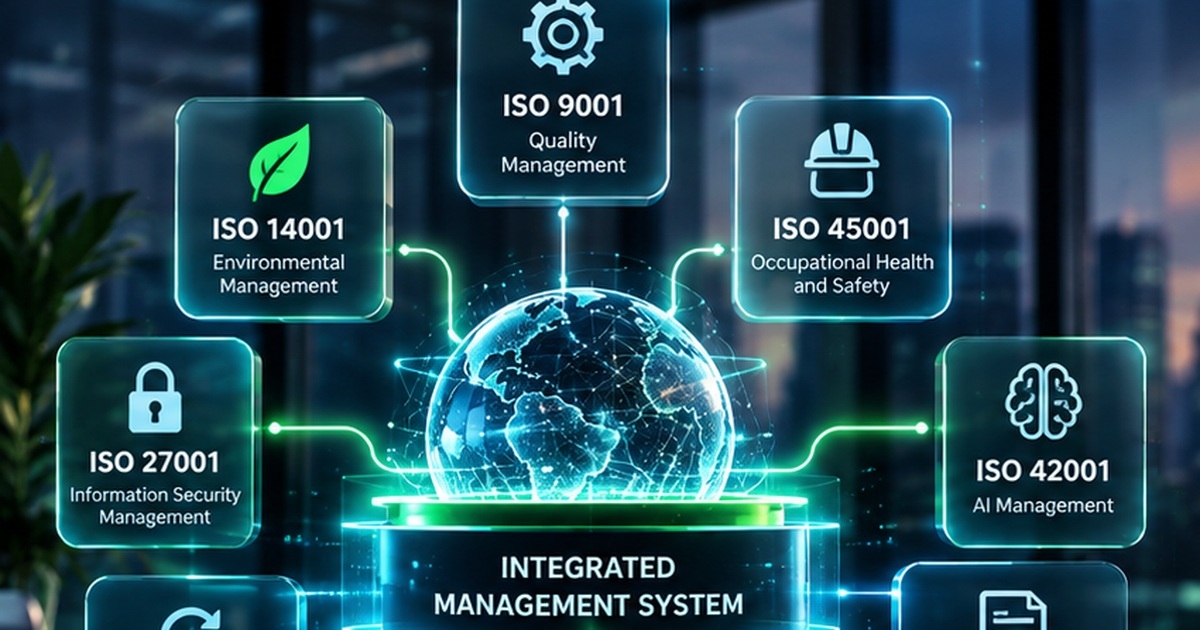
An organisation may operate several management standards, but those standards still govern the same organisation: the same employees, operations, processes, facilities, suppliers and management team, and often many of the same risks and controls. Treating every standard as a completely independent management environment can therefore create unnecessary duplication. An integrated approach takes a different view: instead of asking how each standard can be managed separately, organisations can identify where requirements intersect and decide how common processes should be managed consistently.
Integration Does Not Mean Removing Important Differences
Integrated management does not mean every standard becomes identical. Different frameworks can contain specialist requirements that need dedicated processes, expertise and controls, and the objective is not to eliminate those differences but to identify where integration genuinely makes sense. Common processes such as document control, audits, corrective actions, risk management, objectives and management review often benefit from a more consistent organisational approach, while specialist requirements can remain specialised within that broader framework. This lets organisations preserve the depth each standard requires without unnecessarily duplicating the governance activities they share.
Integration Changes the Management Model
Bringing common requirements together creates an opportunity to manage them through shared organisational processes: a finding can trigger an action, that action can have a responsible owner, evidence can be retained against the process, and risks can be linked to the relevant activities, giving management a more consolidated view of organisational performance. This changes the role of the management system itself. Instead of separate systems documenting separate requirements, the organisation starts building real connections between its governance activities, and the result is not simply fewer systems but better-connected governance.
Integration Strengthens Accountability
Fragmentation makes accountability difficult to follow. An audit finding may exist in one system while the associated action is recorded somewhere else, supporting evidence sits in a departmental folder, and the responsible person receives reminders by email, so management only discovers an action is still outstanding when the next report is prepared. A connected approach makes it possible to establish clearer relationships between findings, responsibilities, actions and evidence, so management can more easily understand:
- What requires attention
- Who is responsible
- When an action is due
- What evidence supports completion
- Whether an issue has been resolved
- Where escalation may be required
Accountability becomes far easier to manage once the process itself is connected.
Integrated Information Improves Management Visibility
Management systems generate genuinely valuable organisational information: audit results reveal control weaknesses, corrective actions show where improvement is needed, risk assessments identify exposure, objectives demonstrate progress, management reviews highlight recurring issues, and performance indicators show where processes are drifting outside expectations. When that information stays separated by standard or department, leadership only ever sees part of the picture. Bringing it together gives management the opportunity to develop a broader understanding of how the organisation is performing across its whole management environment, rather than reviewing isolated reports one at a time.
Integration Can Improve Audit Readiness
Audits often reveal the true operational cost of fragmentation, as teams start searching for documents, evidence gets requested, different versions need to be reconciled, corrective actions are reviewed, records are pulled from various departments, and information is manually assembled to demonstrate what actually happened. The organisation may well be compliant, but proving it can take considerable effort. A connected management environment lets evidence form part of the process as activities happen, which reduces the need to reconstruct information before an audit and improves traceability across management-system processes. Audit readiness becomes part of normal management rather than a scramble performed shortly before an assessment.
Technology Is Changing Integrated Management Systems
As organisations grow, managing multiple standards manually becomes increasingly difficult, with more requirements, more documents, more audits, more risks, more corrective actions, more evidence, more reporting and more stakeholders to keep track of by hand. Technology can help organisations move away from disconnected management processes toward a more structured environment. A modern integrated management system can support organisations in:
- Centralising management-system information
- Standardising common processes
- Connecting findings and corrective actions
- Establishing clearer accountability
- Improving document control
- Linking risks with relevant activities
- Maintaining supporting evidence
- Improving audit readiness
- Strengthening management reporting
- Creating greater organisational visibility
The objective is not simply to digitise existing fragmentation; it is to build a better operating model on top of it.
MSX®: Bringing Management Systems Together
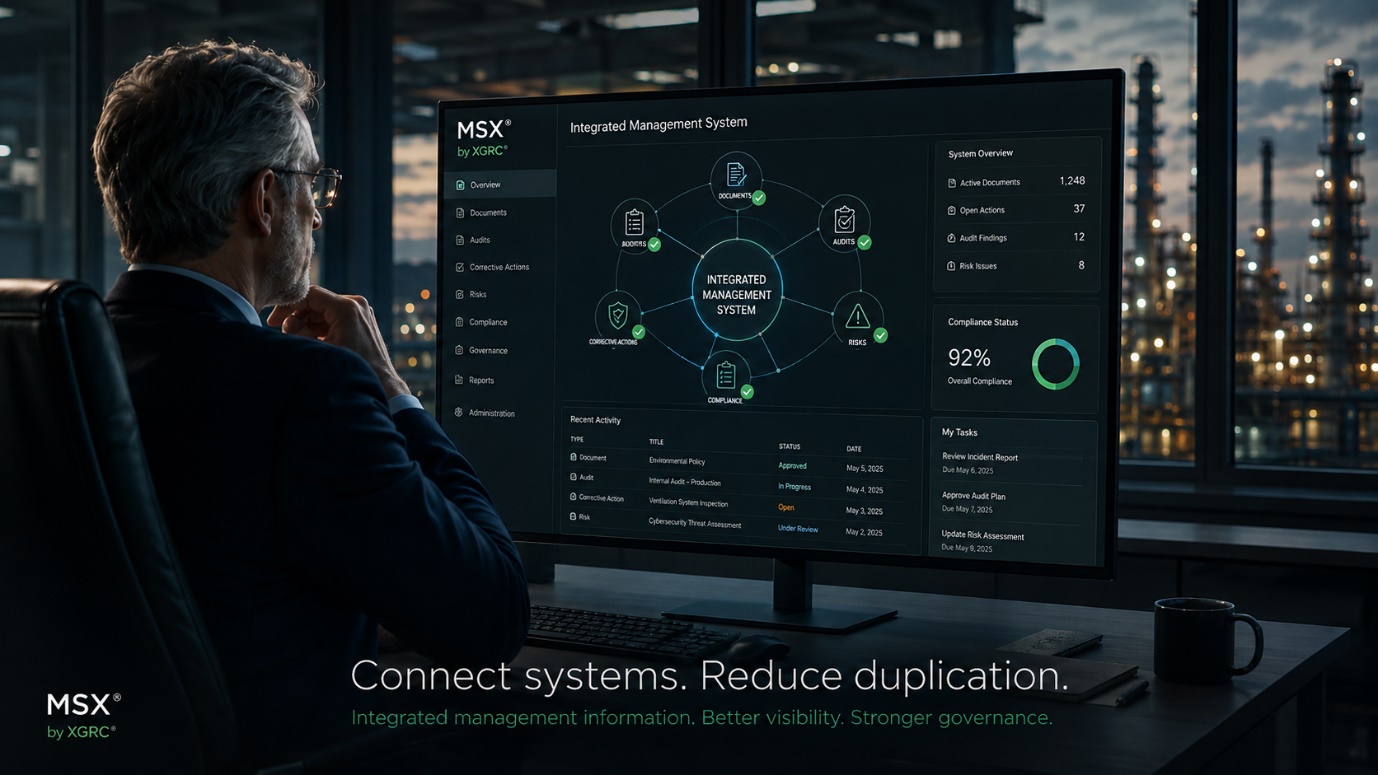
MSX® by XGRC® Software provides an integrated environment for organisations seeking to manage multiple management-system requirements through a more consistent structure. Rather than treating management standards as completely separate environments, MSX® supports a more integrated approach to common management-system processes, allowing organisations to create greater consistency while still maintaining the requirements relevant to individual standards. The result is a management environment designed around connection rather than fragmentation.
Turning Management Requirements Into Controlled Processes
An integrated approach becomes more valuable once requirements translate into structured organisational activity. Operating within the XGRC® Platform and powered by XLOGIC® Executable Governance Architecture, MSX® supports structured workflows, accountability and traceability across management-system processes, connecting management requirements with execution: a requirement can form part of a process, a finding can generate an action, that action can be assigned, responsibility can be established, evidence can support its completion, and management can maintain oversight throughout. The organisation moves away from isolated compliance activities toward a more integrated, controlled and auditable management environment.
Integration Should Reduce Complexity
As organisations grow, management systems inevitably become more complex, with more standards introduced, more business units involved, more responsibilities to coordinate and more information to manage. But complexity does not have to mean fragmentation. A well-designed integrated approach should make governance easier to understand, responsibilities clearer and information easier to access, and that distinction matters: digital transformation should not simply reproduce every existing silo inside new technology. It should be an opportunity to reconsider how management processes work together in the first place.
The Future of Management Systems Is Integrated
The value of integration is not simply having fewer applications; it is creating stronger connections between the work the organisation already does, documents with processes, risks with controls, audits with findings, findings with corrective actions, actions with accountability, evidence with completion, objectives with performance, and management information with decision-making. The goal is not simply to digitise every existing process but to build a better way of managing them together, because the true value of integration is not having everything in one place. It is making everything work as one system.
Bring Your Management Systems Together
Running multiple management standards does not have to mean running multiple disconnected management environments. MSX® by XGRC® Software helps organisations bring management-system requirements into a more integrated structure, supporting controlled workflows, clearer accountability and greater traceability. The opportunity is not simply to replace spreadsheets or consolidate systems; it is to reduce fragmentation and build a management environment that works more effectively as a whole. Speak to an XGRC® specialist to find out how MSX® can help your organisation move from siloed management processes toward a more integrated, controlled and auditable management environment. For the framework behind integration, see what PAS 99 is, and for choosing a platform, integrated management system software for modern compliance.