
Your ESG report is only as credible as the materiality assessment behind it.
Every ESG disclosure starts with a decision about what matters. XGRC® ESG runs the materiality assessment as a recorded process: who was consulted, how each topic was scored and why, so the topics you report on can be defended to investors, auditors and your own board.
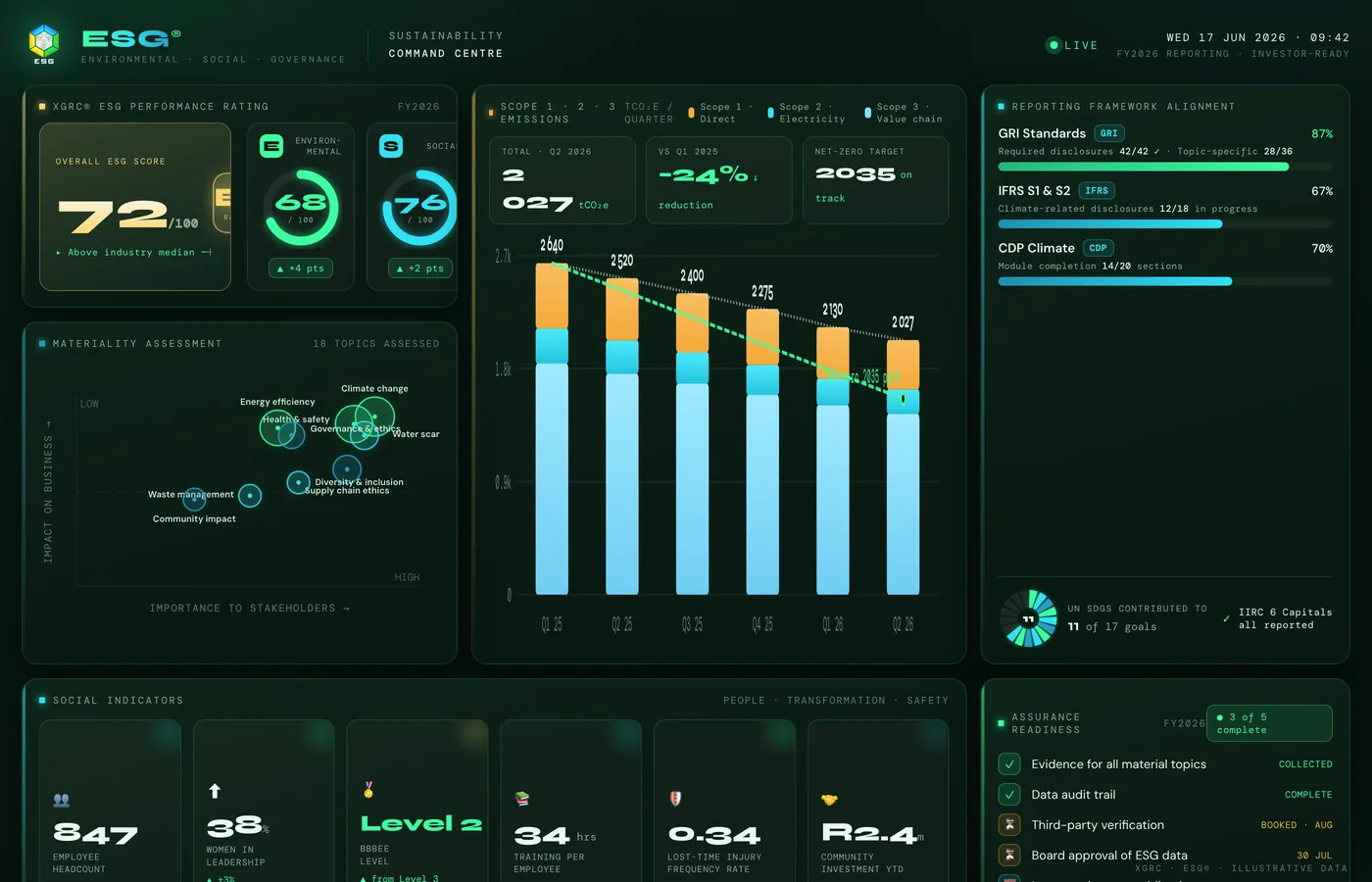
Most materiality assessments end as a slide, not a system.
A materiality matrix in last year's report does not show how it was produced. When an auditor or investor asks why a topic was left out, the answer depends on who still remembers the workshop.
-
Material topics chosen in a workshop, with no record of how the decision was made
-
Stakeholder input gathered once by a consultant and filed away
-
The same topic list reused every year without being reassessed
-
No link between material topics and the targets and metrics actually reported
From long list to reported topics, with the reasoning kept.
- 01
Build a long list of sustainability topics from your sector, frameworks, peers and risks
- 02
Identify stakeholders and record how and when each group was engaged
- 03
Score each topic on impact on people and the environment, and on financial effect on the business
- 04
Set thresholds, agree the material topics and record the reasoning behind each decision
- 05
Link every material topic to an owner, objectives, targets and indicators
- 06
Reassess when the business, its markets or stakeholder expectations change
Built for sustainability leads, signed off by the board.
- A materiality assessment module that records topics, scores, thresholds and reasoning
- Stakeholder engagement records linked to the topics they informed
- Material topics linked to ESG strategy, business strategy, objectives and targets
- Indicator thresholds that show progress on each material topic through the year
- An audit trail behind every decision, ready for assurance
 ESG
Materiality that drives the rest of ESG
In XGRC® ESG, the material topics decide what is measured, targeted and reported. Climate-related topics connect to the climate risk register and to enterprise risk, so materiality, risk and disclosure stay consistent.
The same assessment, with an answer to "why?"
Manual approach: Topics agreed in a workshop
ESG approach: Every score and decision recorded
Manual approach: Stakeholder input in a consultant's report
ESG approach: Engagement linked to each topic
Manual approach: Last year's matrix reused
ESG approach: Reassessed on a schedule
Manual approach: Topics disconnected from metrics
ESG approach: Each topic linked to targets and indicators
ESG Materiality Assessment Checklist
- Topic long list and sources
- Stakeholder identification and engagement
- Impact materiality scoring
- Financial materiality scoring
- Thresholds, approval and reasoning
- Links to targets, disclosure and reassessment
Explore the connected platform.
Solution ESG
Environmental, Social & Governance Reporting
Explore ESG → Use Case ESG Reporting
XGRC® is ESG reporting software that enables organisations to collect, manage and report ESG data in a structured and consistent way. It brings environmental, social and governance data into a single platform, providing clear visibility and supporting informed decision-making.
View use case → Regulatory IFRS S1 & S2 Readiness
The ISSB standards ask for sustainability and climate information with the same discipline as financial reporting: governance, strategy, risk management, metrics and targets, all connected. XGRC® ESG collects that information through owned workflows with an audit trail, so your disclosures can be assured.
View use case → Use Case
Enterprise Risk Management
XGRC® provides a central ERM platform aligned to ISO 31000, COSO, and King V. Define your risk framework, identify and assess risks across all categories, link every risk to controls and audit findings, and report to the board with real-time visibility.
View use case →Common questions.
01What is an ESG materiality assessment?
It is the process an organisation uses to decide which environmental, social and governance topics matter most, and therefore which ones it manages, targets and reports on. It draws on stakeholder input, business strategy, risks and the frameworks you report to.
02What is the difference between impact and financial materiality?
Impact materiality looks outward: the effect your organisation has on people and the environment, which is the GRI view. Financial materiality looks inward: how sustainability matters affect your cash flows, cost of capital and value, which is the IFRS S1 and S2 view. Assessing both is often called double materiality.
03How often should a materiality assessment be repeated?
Most organisations do a full assessment every two to three years and a lighter review every year, plus a reassessment whenever there is a major change such as an acquisition, a new market or new regulation.
04How does XGRC® link materiality to reporting?
Each material topic in XGRC® ESG is linked to its owner, objectives, targets and indicators, and through them to the GRI index, IFRS S1/S2 alignment and CDP responses. A topic cannot quietly drop out of the report without a recorded decision.
See a materiality assessment you can defend line by line.
Book a demo to see XGRC® ESG run materiality, stakeholder engagement and targets as one connected, auditable process.
Where should we send your download link?
Enter your details and we will email you the link to the checklist.
Your checklist is ready.
Click the button below to download the PDF. We have also sent this link to your email.
Download the checklist (PDF)