
IFRS S1 and S2 put sustainability disclosure next to the financial statements. The evidence has to match.
The ISSB standards ask for sustainability and climate information with the same discipline as financial reporting: governance, strategy, risk management, metrics and targets, all connected. XGRC® ESG collects that information through owned workflows with an audit trail, so your disclosures can be assured.
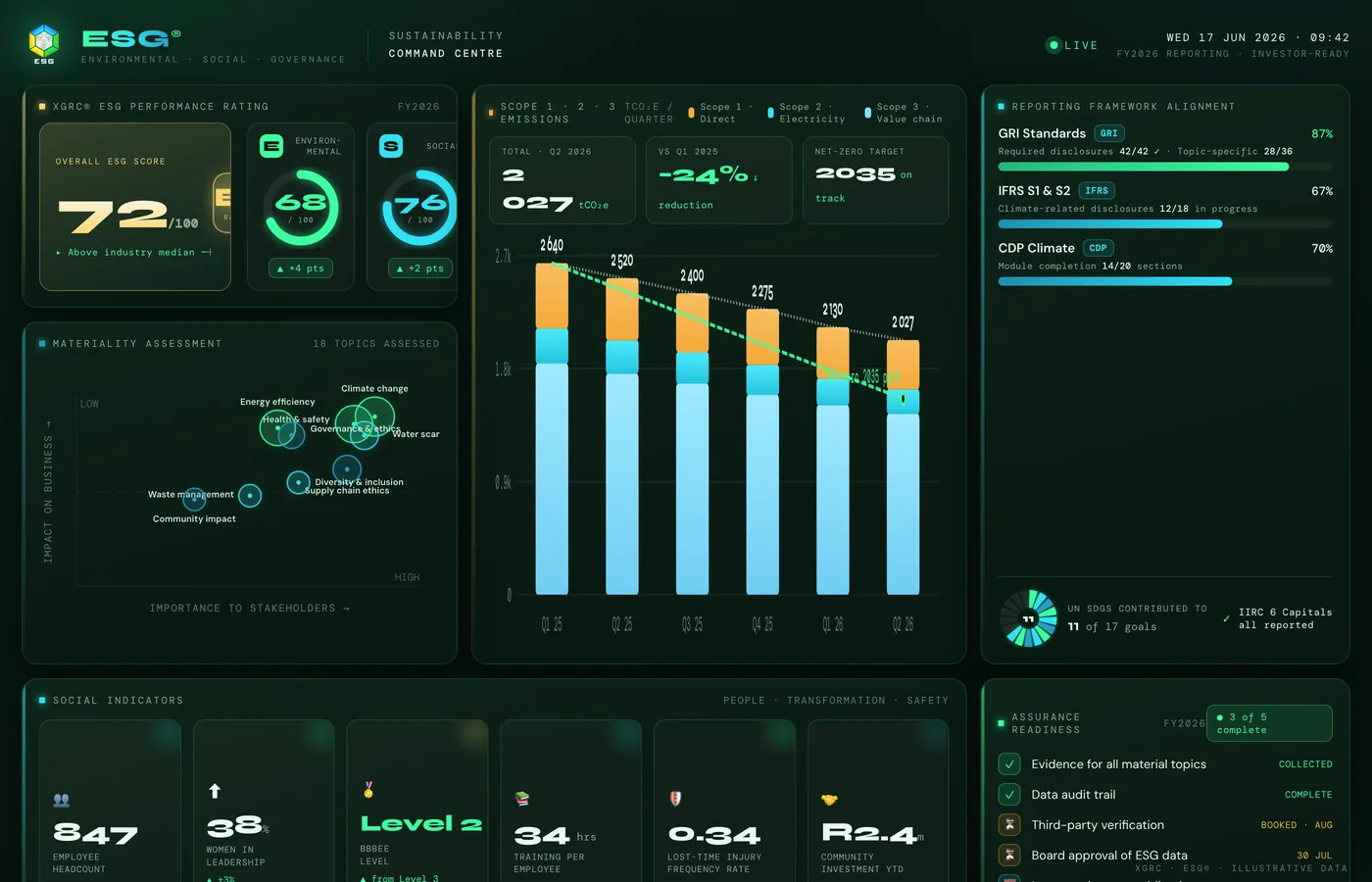
ISSB disclosures expose the gaps between sustainability and finance.
IFRS S1 and S2 expect sustainability information to be reported alongside the financial statements, for the same entity and period, with the same rigour. Organisations that built ESG reporting as a separate annual exercise find the data, the controls and the governance are not ready.
-
Climate risk discussed by the board but not recorded in a way that can be disclosed
-
Scope 3 emissions not yet measured, or estimated with no method recorded
-
Sustainability data collected by a different team, on a different timetable, from the financial report
-
No evidence trail an assurance provider could test
The four ISSB pillars, run as one process.
- 01
Confirm whether and when IFRS S1 and S2, or a local version of them, apply to you
- 02
Document how the board and management oversee sustainability and climate-related risks and opportunities
- 03
Identify climate-related risks and opportunities and their effect on strategy, business model and finances
- 04
Integrate climate risk into enterprise risk management, with the process disclosed
- 05
Measure Scope 1, 2 and 3 emissions and the cross-industry and industry-based metrics
- 06
Set targets, track progress and collect evidence that can be assured
Built for sustainability and finance teams working together.
- IFRS S1/S2 alignment mapped to the data, owners and evidence behind each disclosure
- A climate risk register connected to enterprise risk management
- Scope 1, 2 and 3 emissions tracking, with environmental data from ENVIRX®
- Objectives, targets and indicator thresholds tracked through the year
- An audit trail and evidence repository behind every data point
 ESG
Climate risk in the risk register, not a separate report
XGRC® ESG keeps the climate risk register on the same platform as XGRC® ERM, so the risks you disclose under IFRS S2 are the risks your board already oversees. Emissions come from ENVIRX®, and Integrated Assurance can test the evidence before the auditor does.
The same disclosures, ready for assurance.
Manual approach: Climate risk in board minutes only
ESG approach: Climate risk register linked to ERM
Manual approach: Scope 3 not yet estimated
ESG approach: Scope 1, 2 and 3 tracked through the year
Manual approach: ESG data on its own timetable
ESG approach: Owned data on the reporting timetable
Manual approach: Evidence collected after the report
ESG approach: Evidence attached as data is captured
IFRS S1 & S2 Readiness Checklist
- Applicability, timing and transition reliefs
- Governance of sustainability and climate
- Strategy, business model and resilience
- Risk management integration
- Scope 1-3 emissions and climate metrics
- Targets, controls and assurance readiness
Explore the connected platform.
Solution ESG
Environmental, Social & Governance Reporting
Explore ESG → Use Case ESG Materiality Assessment
Every ESG disclosure starts with a decision about what matters. XGRC® ESG runs the materiality assessment as a recorded process: who was consulted, how each topic was scored and why, so the topics you report on can be defended to investors, auditors and your own board.
View use case → Use Case
Carbon Footprint & Emissions
Investors, customers and auditors no longer accept a carbon number on its own. They ask where it came from. ENVIRX® calculates your carbon footprint and Scope 1, 2 and 3 emissions from source readings, invoices and systems, and keeps the trail from every reported figure back to the data that produced it.
View use case → Use Case ESG Reporting
XGRC® is ESG reporting software that enables organisations to collect, manage and report ESG data in a structured and consistent way. It brings environmental, social and governance data into a single platform, providing clear visibility and supporting informed decision-making.
View use case →Common questions.
01What are IFRS S1 and IFRS S2?
They are the first two standards from the International Sustainability Standards Board (ISSB). IFRS S1 sets general requirements for disclosing sustainability-related risks and opportunities. IFRS S2 sets specific requirements for climate-related disclosures, including Scope 1, 2 and 3 greenhouse gas emissions.
02Do IFRS S1 and S2 apply to us?
It depends on where you are listed or regulated. The standards apply when a jurisdiction or exchange adopts them, and many are doing so, often with local adaptations. Even where they are not mandatory, investors and lenders increasingly ask for ISSB-aligned information.
03How do IFRS S1 and S2 relate to TCFD?
IFRS S2 builds on the TCFD recommendations and uses the same four pillars: governance, strategy, risk management, and metrics and targets. Organisations already reporting to TCFD have a head start, but IFRS S2 adds requirements such as industry-based metrics and Scope 3 emissions.
04What reliefs are available in the first year?
IFRS S1 and S2 include transition reliefs. In the first year you may report on climate only, you do not have to disclose Scope 3 emissions, and comparative information is not required. Check whether your regulator has adopted the same reliefs.
See IFRS S1 and S2 readiness as a system, not a scramble.
Book a demo to see XGRC® ESG connect governance, climate risk, emissions and evidence for ISSB-aligned disclosure.
Where should we send your download link?
Enter your details and we will email you the link to the checklist.
Your checklist is ready.
Click the button below to download the PDF. We have also sent this link to your email.
Download the checklist (PDF)