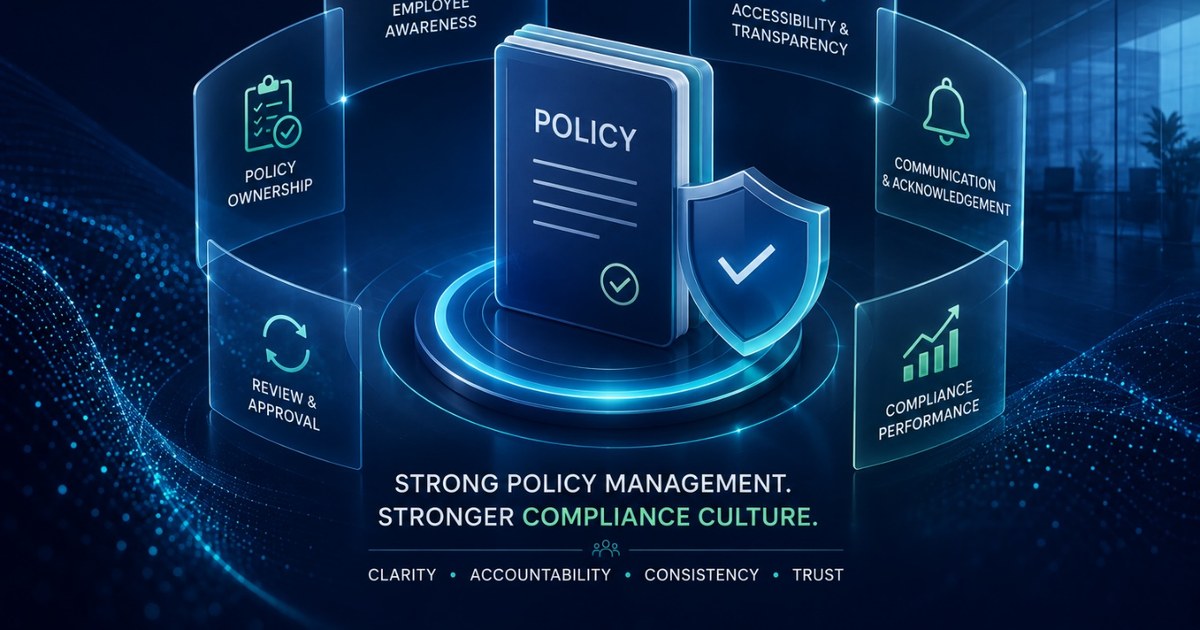
A strong compliance culture is not created by policies alone.
It is created when people understand what is expected of them, know where to find the information they need, and take responsibility for applying policies in their everyday work.
Yet for many organisations, policy management remains fragmented. Policies may be stored across shared drives, emails, intranets, spreadsheets, or individual departments. Different versions circulate throughout the business. Employees may be uncertain whether they are using the latest document, while management has limited visibility into whether policies have been communicated, reviewed, or acknowledged.
The result is more than an administrative problem. Poor policy management can weaken compliance culture. The mechanics of exactly where that gap opens up, between a policy being approved and it actually being practised, are covered in policy management versus governance execution. This article looks at the other half of the problem: what it takes for people to actually adopt those expectations as culture, not just process.
Why Policies Matter to Compliance Culture
Policies translate governance requirements into practical expectations. They establish how employees should behave, how processes should operate, and how the organisation responds to risk.
However, publishing a policy does not mean it will automatically influence behaviour. Employees need to understand which policies apply to their responsibilities, where current policies can be accessed, what has changed when policies are updated, what actions are expected of them, and who owns and maintains each policy. When these fundamentals are missing, policies can quickly become disconnected from everyday operations.
Effective policy governance closes this gap by connecting expectations with the people responsible for implementing them.
Fragmented Policy Management Creates Compliance Risk
As organisations grow, the number of policies they manage often increases significantly. Without a structured approach, maintaining those policies becomes increasingly difficult.
Documents can become outdated. Review dates may be missed. Employees may work from superseded versions. Ownership can become unclear, and demonstrating that employees received or acknowledged important policies can become challenging.
These weaknesses can create several risks: inconsistent policy application, limited employee awareness, poor document control, missed reviews and approvals, unclear accountability, increased audit complexity, and greater exposure to compliance failures. A strong compliance culture requires confidence that organisational expectations are both understood and consistently applied. That begins with stronger policy governance.
Policy Ownership Creates Accountability
Accountability is one of the foundations of effective compliance. Every policy should have clear ownership. Someone must be responsible for maintaining the policy, coordinating reviews, managing approvals, communicating changes, and ensuring the document remains relevant.
Employees also need to understand their responsibilities. A structured policy management process establishes this ownership and creates greater transparency across the organisation. Instead of policies becoming static documents stored somewhere in the business, they become actively managed governance tools. This helps create a culture where compliance responsibilities are visible rather than assumed.
Accessibility Supports Better Compliance
Even the best policy provides little value if employees cannot find it. When documents are spread across multiple locations, employees may rely on old copies, ask colleagues for guidance, or make decisions without consulting the appropriate policy.
Centralised policy management provides employees with a reliable source for current information. Greater accessibility helps employees make informed decisions while reducing uncertainty about organisational expectations. It also reinforces an important cultural message: compliance is part of everyday business. When governance information is easy to access and understand, employees are more likely to incorporate it into routine decision-making.
Consistency Turns Policy into Practised Standard
Compliance culture depends on consistency. The same governance expectations should apply regardless of department, location, or individual employee.
Structured policy management helps organisations establish this consistency by controlling how policies are created, reviewed, approved, communicated, and maintained. It can also provide greater confidence that employees are working from the correct information. This becomes particularly important for organisations operating across multiple sites or business units, where inconsistent processes can create significant governance and operational risks. A consistent approach strengthens organisational alignment and helps turn policies into practical standards for behaviour.
Better Policy Governance Strengthens Audit Readiness
Audits often require organisations to demonstrate more than the existence of a policy. Auditors may need evidence that policies are current, appropriately approved, regularly reviewed, communicated to relevant employees, and effectively controlled.
When policy management relies on spreadsheets, emails, and manual document storage, gathering this evidence can consume significant time. A structured approach improves visibility and provides a clearer governance trail. Organisations can respond to audits with greater confidence because policy information is organised and accountability is easier to demonstrate. More importantly, audit readiness becomes an ongoing capability rather than a last-minute exercise.
Technology Turns Policy Ownership into Everyday Behaviour
Managing policies manually becomes increasingly difficult as organisations grow. Technology can provide the structure required to manage policies throughout their lifecycle while reducing administrative complexity.
A connected approach to policy management can help organisations establish stronger processes around policy creation and ownership, review and approval, version control, distribution and accessibility, employee acknowledgement, scheduled reviews, and governance oversight. The objective is not simply to digitise documents. It is to create a controlled environment where policies remain current, accessible, accountable, and connected to organisational compliance.
How XLOGIC® Supports Stronger Policy Management
Building a strong compliance culture requires organisations to make governance part of everyday operations. XLOGIC® converts policies, frameworks, controls, and obligations into structured workflows with clear accountability, evidence capture, and auditability, so a policy is not just published but tracked through to the people responsible for applying it.
Instead of relying on fragmented documents and manual processes, organisations can establish a more consistent approach to managing important policy information. This helps organisations strengthen policy governance, document control, organisational accountability, employee access to information, consistency across operations, and compliance oversight. By improving the way policies are managed, organisations can create stronger connections between governance expectations and everyday employee behaviour.
From Policy Documents to Compliance Culture
Policies should never exist simply to satisfy a compliance requirement. Their real value comes from influencing how people behave and how decisions are made.
When employees understand organisational expectations, have access to current information, and recognise their individual responsibilities, compliance becomes embedded into daily operations. That is when policy management begins to influence culture. Organisations move away from compliance being something managed by a dedicated team and towards an environment where employees across the business actively contribute to governance.
The result is stronger accountability, more consistent decision-making, reduced compliance risk, and a more resilient organisation.