
PAS 99 integrates your management systems on paper. MSX® runs them as one system in practice.
PAS 99 is BSI's specification for integrating two or more management system standards — ISO 9001, ISO 14001, ISO 45001, ISO 22000 — into one common framework instead of running each in its own silo. This checklist covers what PAS 99 integration actually requires, and XGRC® MSX® is the platform that runs the integrated system day to day.
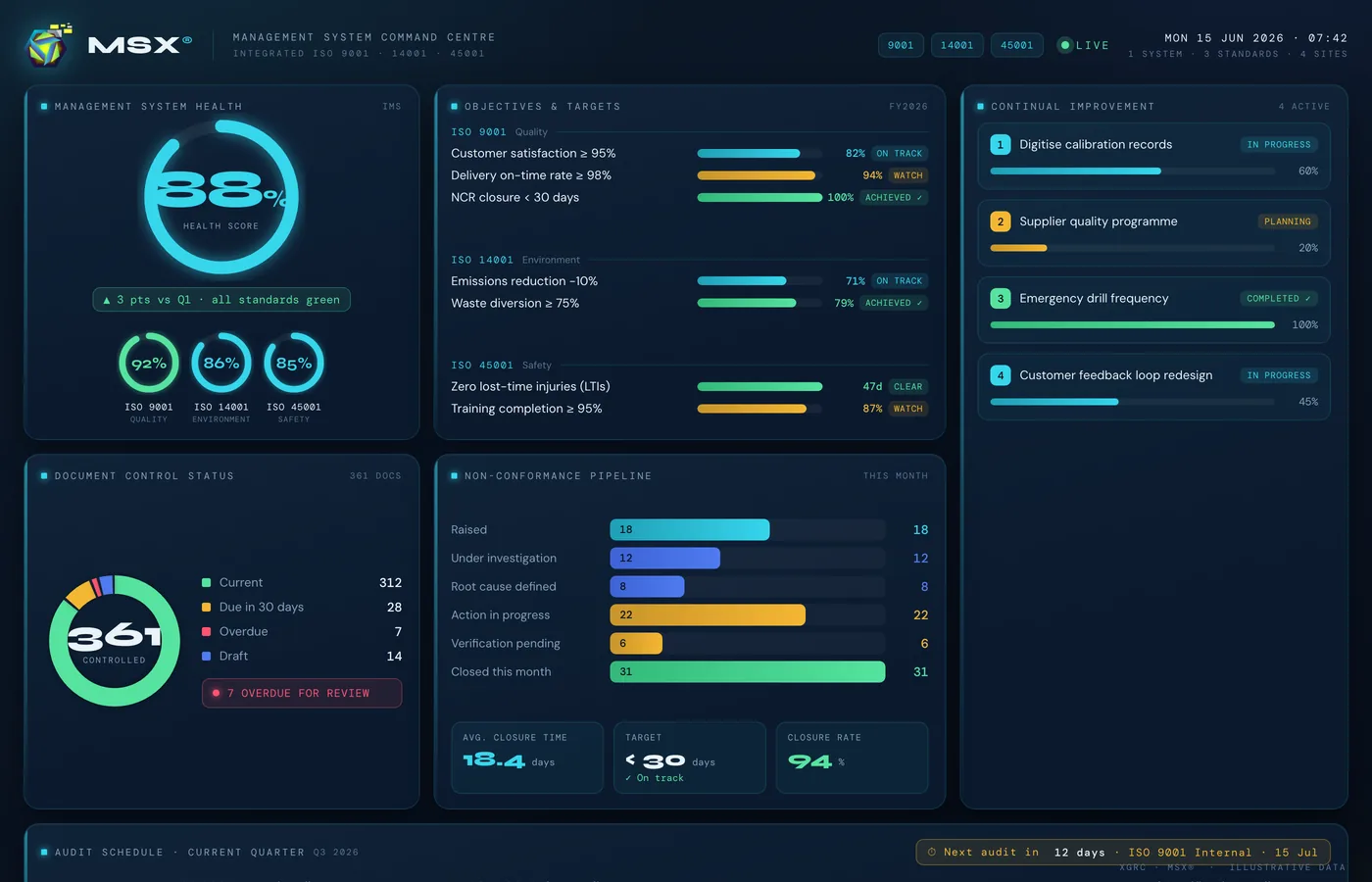
Running certified standards in silos duplicates effort a common framework would remove.
When ISO 9001, 14001 and 45001 (or 22000) are each managed as their own system, the same policies, document control, audits and management reviews get repeated three or four times over instead of run once against a shared structure — exactly what PAS 99 exists to prevent.
-
ISO 9001, 14001 and 45001 each managed in a separate tool, with the same data entered three times
-
Document control duplicated across systems instead of shared once
-
Internal audits run separately per standard, doubling the workload for the same sites
-
No single management review — leadership sees three disconnected reports instead of one
What PAS 99 integration actually requires.
- 01
Map the common clauses across your certified standards — context, leadership, planning, support, operation, performance evaluation, improvement
- 02
Build one integrated policy and set of objectives instead of one per standard
- 03
Consolidate document control so a procedure that serves two standards exists once, not twice
- 04
Run internal audits against the integrated system, covering all standards in the same audit programme
- 05
Hold one management review that covers every integrated standard, not a separate meeting per certificate
- 06
Track corrective actions and continual improvement across the whole integrated system, not per silo
Built for organisations running more than one certified standard.
- One document manager and version control shared across every integrated standard
- A single audit programme covering ISO 9001, 14001, 45001 and 22000 requirements in one pass per site
- Shared governance, objectives and performance evaluation across the integrated system
- Nonconformance and corrective action tracking that applies across standards, not siloed per certificate
- One management review dashboard instead of one per standard
 MSX®
One coordinated programme, not three parallel ones
MSX® is XGRC®'s integration layer for organisations running two or more ISO management system disciplines. Document control, governance workflows, audit management and performance evaluation are shared across every standard you have certified, so the same evidence and the same audit visit serve all of them at once.
The same certifications. One system running them, not three.
Manual approach: Separate document sets per standard
XGRC® approach: One document manager shared across every standard
Manual approach: Separate audit programmes for the same sites
XGRC® approach: One audit programme covering every certified standard
Manual approach: Separate management review meetings
XGRC® approach: One management review across the integrated system
Manual approach: Corrective actions tracked per silo, patterns missed across standards
XGRC® approach: Corrective actions and patterns visible across standards, not siloed
PAS 99 Integrated Management System Readiness Checklist
- Common clause mapping across your certified standards
- Integrated policy, objectives and governance
- Shared document control
- Consolidated audit programme
- Single management review and improvement
Explore the connected platform.
Solution MSX®
Integrated Management System
Explore MSX® → ISO Readiness
ISO 9001 Readiness
XGRC® SHEQX® gives organisations a structured way to assess ISO 9001 readiness, close quality management gaps, and run the QMS as a living system — not a folder of documents produced for the auditor.
View use case → ISO Readiness ISO 45001 Readiness
SHEQX® by XGRC® gives organisations a structured way to assess ISO 45001 readiness, close OH&S management gaps, and run hazard identification, incident management and contractor safety as one connected system.
View use case → ISO Readiness ISO 14001 Readiness
SHEQX® by XGRC® gives organisations a structured way to assess ISO 14001 readiness, close environmental management gaps, and monitor compliance obligations continuously, not reconstruct evidence for the auditor.
View use case →Common questions.
01What is PAS 99?
PAS 99 is a Publicly Available Specification published by BSI for integrating two or more management system standards — such as ISO 9001, ISO 14001, ISO 45001 and ISO 22000 — into one common framework built around their shared clause structure, instead of running each as a separate system.
02Is PAS 99 an ISO standard?
No. PAS 99 is a BSI specification, not an ISO standard, but it is built directly on the common high-level structure that modern ISO management system standards already share, which is what makes integration possible.
03Do I need to be certified to all of ISO 9001, 14001 and 45001 to use this checklist?
No. PAS 99 integration applies to any two or more management system standards you hold. Most organisations start with two — commonly quality and health & safety, or quality and environmental — and integrate further standards as they add certifications.
04How is MSX® different from running SHEQX® on its own?
SHEQX® manages safety, health, environment and quality as one discipline in depth. MSX® sits above that as the integration layer for organisations coordinating multiple ISO management-system disciplines — document control, audit and management review shared across all of them — and is optional, not required to use SHEQX® or any other XGRC® solution.
See ISO 9001, 14001, 45001 and 22000 running as one system.
Book a demo to see how MSX® coordinates document control, audit and management review across every standard in your integrated management system.
Where should we send your download link?
Enter your details and we will email you the link to the checklist.
Your checklist is ready.
Click the button below to download the PDF. We have also sent this link to your email.
Download the checklist (PDF)