
The EU AI Act asks one question per AI system: what is it, and what do you owe?
The EU AI Act regulates AI system by system. Your duties depend on what each system does, where it is used and whether you built it or deploy it. XGRC® AI Governance records that decision for every system, scopes the obligations that follow and keeps the evidence that you meet them.
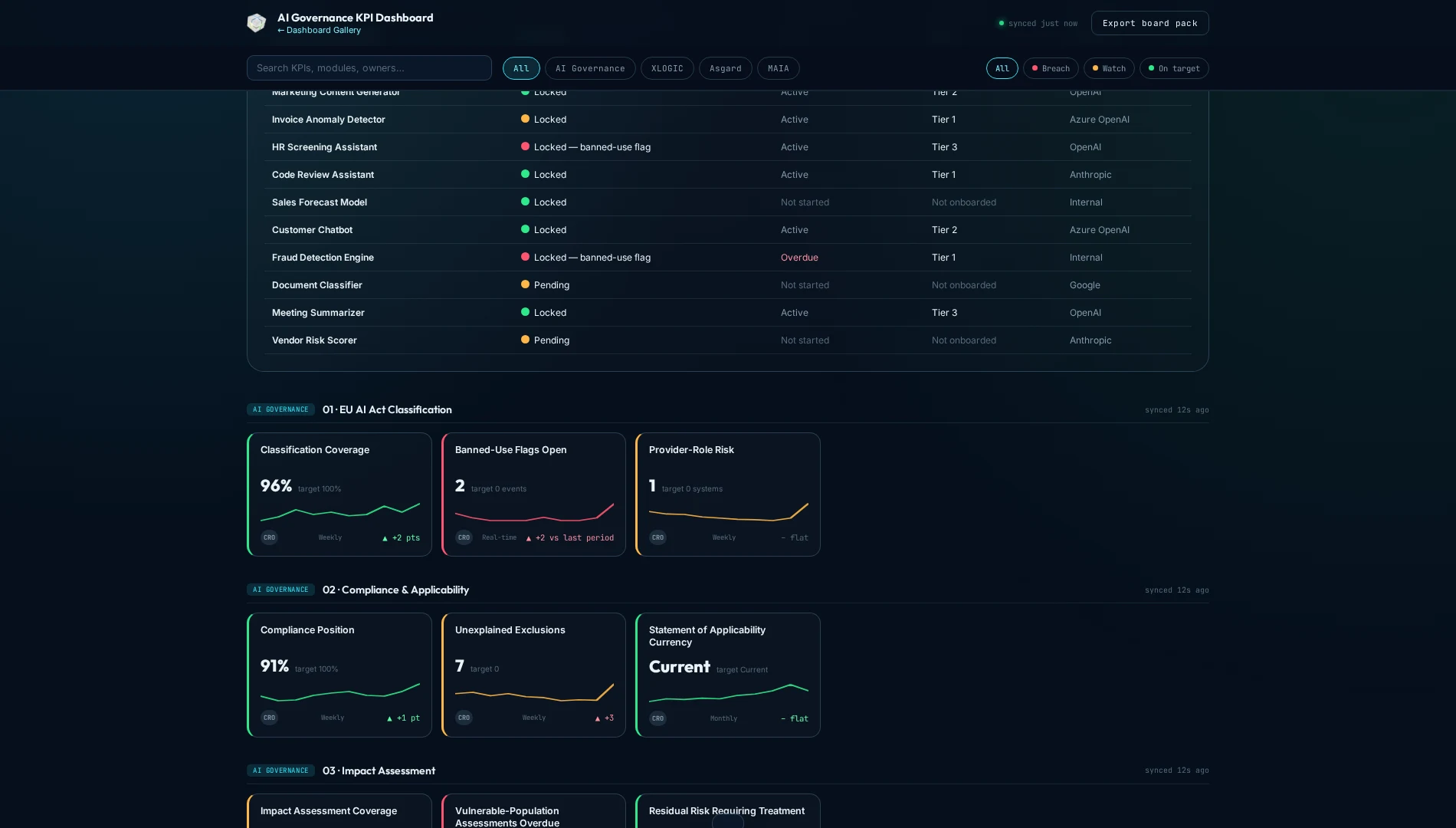
Most organisations know the AI Act exists. Few can show where each system stands.
The Act does not ask whether your organisation uses AI responsibly in general. It asks, for each system, which category it falls into, what your role is and what that requires. Without a recorded answer, every audit, customer questionnaire and regulator query starts from zero.
-
Nobody can say which AI systems are high risk, limited risk or out of scope
-
Classification decisions made in meetings and never written down with the legal reasoning
-
Teams unsure whether they are the provider or the deployer of a tool they bought and then changed
-
Transparency, logging and oversight duties known in principle but not tracked per system
From AI inventory to scoped, evidenced obligations.
- 01
List every AI system in use, including tools bought in, built in house or switched on inside existing software.
- 02
Check each system against the prohibited practices first, and stop there if one applies.
- 03
Decide the risk tier: high risk, transparency obligations only, or minimal risk, and record the reasoning against the article.
- 04
Confirm your role for each system: provider or deployer, and whether a change has made you the provider.
- 05
Scope only the obligations that fit that tier and role, then record met, partly met or not met with evidence.
- 06
Turn every gap into an owned, dated action, and re-classify when the system changes.
Built for compliance and legal owners, not only AI engineers.
- A guided 18-question EU AI Act decision tree that records every answer against its article
- Approved classifications locked and versioned, so a re-classification never overwrites the last one
- Requirements that scope themselves from the approved tier and role, so a limited-risk deployer sees a short list
- Evidence attached per requirement, with gaps raised as owned actions
- Change rules that send a system back for re-classification when its capability or purpose changes
 AI Governance
The AI Act inside the platform you already run
Classification, compliance, impact, risk, oversight and incidents all sit on the same AI system record in XGRC® AI Governance. The same controls and evidence can answer ISO/IEC 42001, GDPR and POPIA, so one piece of proof is not filed four times.
The same obligations, with a decision you can defend.
Manual approach: AI use described informally
AI Governance approach: Every system classified against its article
Manual approach: Risk tier argued in email, never recorded
AI Governance approach: Approved decisions locked and versioned
Manual approach: Every obligation of the Act read as if it applies
AI Governance approach: Only the obligations for your tier and role
Manual approach: Re-classification only when someone remembers
AI Governance approach: Changes trigger re-classification by rule
EU AI Act Compliance Checklist
- Scope and reach outside the EU
- Prohibited practices and AI literacy
- Risk classification and your role
- Deployer duties for high-risk systems
- Transparency for chatbots and generated content
- Serious incidents and change
Explore the connected platform.
Solution AI Governance
Govern every AI system, from register to regulator: EU AI Act classification, ISO/IEC 42001 readiness, GDPR and POPIA compliance, risk, incidents and oversight in one workspace inside XGRC®.
Explore AI Governance → Use Case AI Governance Readiness
Two laws now sit behind AI governance: ISO/IEC 42001 certifies your organisation's AI management system, and the EU AI Act regulates each AI system individually. This checklist covers what both actually require, so a readiness gap is something you find on your own terms, not an auditor's.
View use case → ISO Readiness ISO/IEC 42001 Readiness
ISO/IEC 42001 certifies the management system around your AI: the policy, the owners, the risk and impact assessments, the controls and the audits that keep it honest. XGRC® AI Governance runs that system all year, so a certification audit tests what is already in place.
View use case → Use Case AI Risk & Incident Management
Bias, fabricated output, data leakage and model drift are business risks like any other, and an AI incident can start a regulator deadline. XGRC® AI Governance scores AI risk with the same discipline as the rest of your risk register, and runs AI incidents against their reporting clocks.
View use case →Common questions.
01Does the EU AI Act apply to organisations outside the EU?
It can. It applies to providers who place AI systems on the EU market wherever they are based, and to providers and deployers outside the EU when the output of their AI system is used in the EU. UK and South African organisations with EU customers, staff or users should check each system.
02What is the difference between a provider and a deployer?
The provider develops an AI system, or has it developed, and places it on the market under its own name. The deployer uses it under its own authority. A deployer becomes the provider if it puts its own name on a high-risk system, makes a substantial modification or changes its intended purpose so that it becomes high risk.
03Do we need to classify AI tools we bought rather than built?
Yes. Buying a tool changes your role, not whether the Act applies. Deployers of high-risk systems have their own duties, such as human oversight by competent people, monitoring, keeping logs and informing affected workers.
04How does XGRC® record a classification?
A guided 18-question decision tree records each answer against its article and produces a tier and role. Once approved, the result is locked. Re-classifying creates a new version, so you can always show what was decided, when and why.
See EU AI Act classification as a decision you can defend.
Book a demo to see the 18-question decision tree, self-scoping requirements and change-triggered re-classification running on your own AI systems.
Where should we send your download link?
Enter your details and we will email you the link to the checklist.
Your checklist is ready.
Click the button below to download the PDF. We have also sent this link to your email.
Download the checklist (PDF)