Managing Environmental Compliance in a Complex Regulatory Landscape
Environmental regulations are becoming increasingly complex as governments introduce stricter sustainability and environmental protection requirements. Organisations must monitor environmental risks, track regulatory obligations, and maintain compliance with environmental management standards such as ISO 14001. However, many organisations still rely on spreadsheets and manual processes to manage environmental compliance. This often leads to fragmented records, limited oversight, and increased risk of non-compliance. Environmental compliance software helps organisations digitise environmental governance, ensuring regulatory obligations are monitored and managed through a structured system. This guide explains what environmental compliance management software does, how environmental obligations software turns permits and licences into a working register, and what to look for when you choose one.
What Is Environmental Compliance Software?
Environmental compliance software enables organisations to track environmental obligations, manage environmental risks, and monitor compliance performance within a centralised digital platform. Instead of managing environmental processes across multiple systems, organisations can use environmental management system software to centralise environmental risk registers, regulatory obligations and legal requirements, environmental incidents and corrective actions, environmental monitoring and reporting, and audit and compliance documentation. This structured approach improves transparency and helps organisations maintain consistent compliance with environmental regulations.
Environmental Obligations Software: Turning Permits into a Register
Most environmental non-compliance does not come from ignoring the law. It comes from losing track of the obligations the law creates. A single operation can hold an environmental authorisation under the National Environmental Management Act 107 of 1998, a water use licence under the National Water Act 36 of 1998, an atmospheric emission licence under the Air Quality Act 39 of 2004 and a waste management licence under the Waste Act 59 of 2008. Each one carries its own conditions, monitoring frequencies, reporting deadlines and renewal dates.
Environmental obligations software breaks those documents down into individual obligations. Each obligation gets an owner, a due date, the evidence that proves it was met and an alert before it falls due. When an auditor or the regulator asks whether a licence condition was complied with, the answer is a record rather than a search through email.
For operations in South Africa, see how environmental compliance software for South African legislation brings these licences together on one platform, or how ENVIRX® manages environmental monitoring and obligations day to day.
Challenges of Manual Environmental Compliance Tracking
Organisations that rely on manual compliance tracking often face operational challenges. Environmental regulations frequently change, making it difficult to maintain up-to-date compliance records without a structured system. Without centralised monitoring, environmental risks may not be identified early enough to prevent compliance issues. When compliance records are spread across departments, reporting becomes difficult and audit preparation takes longer. These challenges increase the importance of adopting digital compliance tools that support environmental governance.
What to Look for in Environmental Regulatory Compliance Management Software
Environmental regulatory compliance management software should make it easy to answer one question at any time: which obligations apply to this site, and can we prove each one is being met? When comparing environmental compliance management software, look for:
- An obligations register built from your actual authorisations, licences and permits, not only a generic list of legislation
- An owner, due date, evidence requirement and alert for every obligation and licence condition
- Monitoring data for air, water, noise, waste, energy and biodiversity captured against the obligations it proves
- Environmental incidents and non-conformances linked to corrective actions with an audit trail
- Multi-site consolidation, so group reporting does not depend on reconciling site spreadsheets
- Alignment with ISO 14001, including legal compliance and audit management
- A connection to ESG reporting and enterprise risk, so environmental data is captured once and reused
Where the legislation itself needs to be tracked as it changes, jurisdiction-specific regulatory intelligence from Libryo can be embedded within XGRC® to support the legal register.
How ENVIRX® Supports Environmental Governance
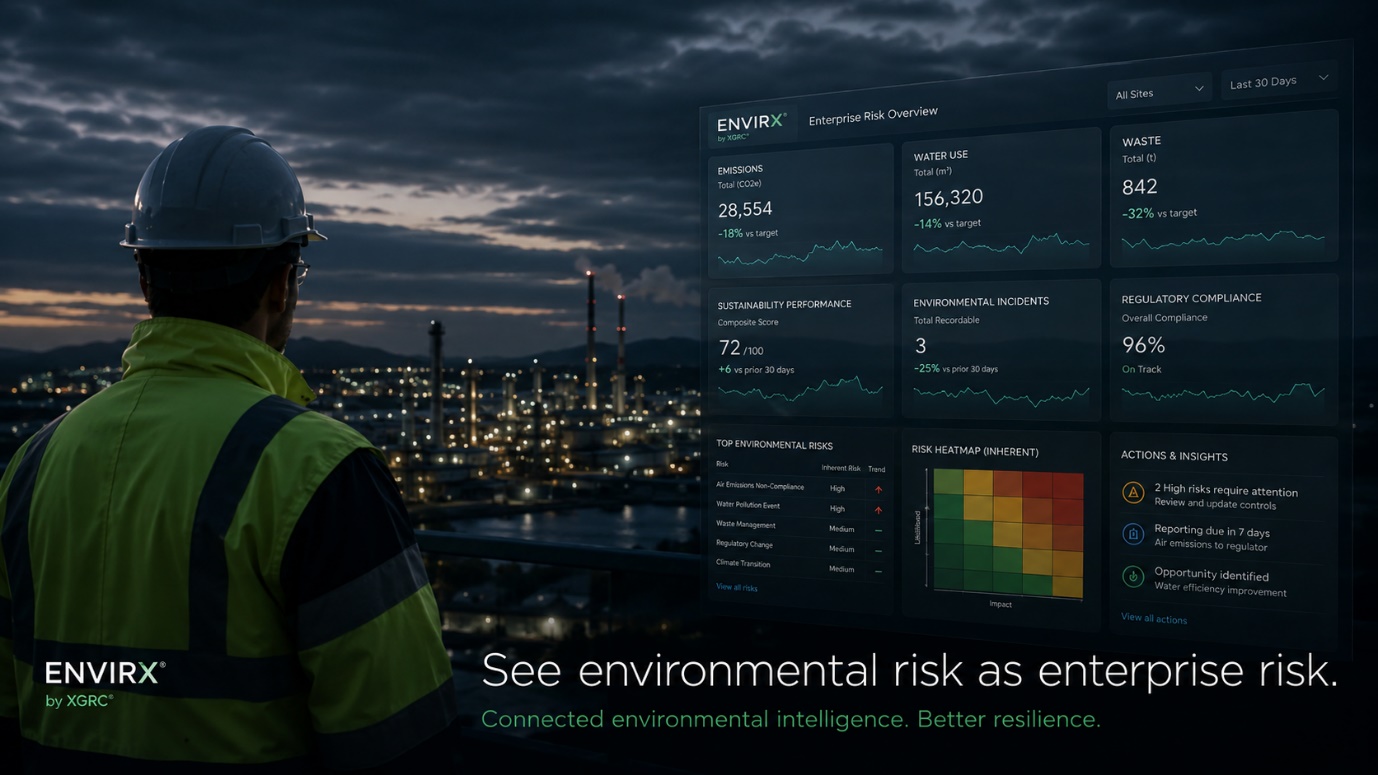
ENVIRX®, part of the XGRC® platform, provides organisations with the tools needed to manage environmental compliance and risk within a structured governance framework. Key capabilities include environmental risk management (identify, assess, and monitor environmental risks across operations), legal compliance tracking (track environmental regulations and obligations to ensure ongoing compliance), environmental incident management (capture environmental incidents and manage corrective actions through structured workflows), and compliance monitoring and reporting (provide leadership teams with visibility into environmental performance and compliance status).
Benefits of Environmental Compliance Software
Implementing environmental compliance software offers several operational advantages: stronger regulatory compliance through structured tracking, improved risk visibility through centralised reporting and analytics, better audit readiness through centralised documentation, and more efficient compliance management through automated tracking.
Integrated Environmental Governance with XGRC®
Environmental compliance does not exist in isolation. Organisations must manage environmental governance alongside broader risk management and compliance frameworks. ENVIRX® operates within the XGRC® platform, enabling organisations to manage environmental risks, regulatory obligations, and compliance monitoring within a unified governance system. This approach supports SYNERGY IN ASSURANCE and strengthens organisational governance through STRENGTH IN COMPLIANCE®.