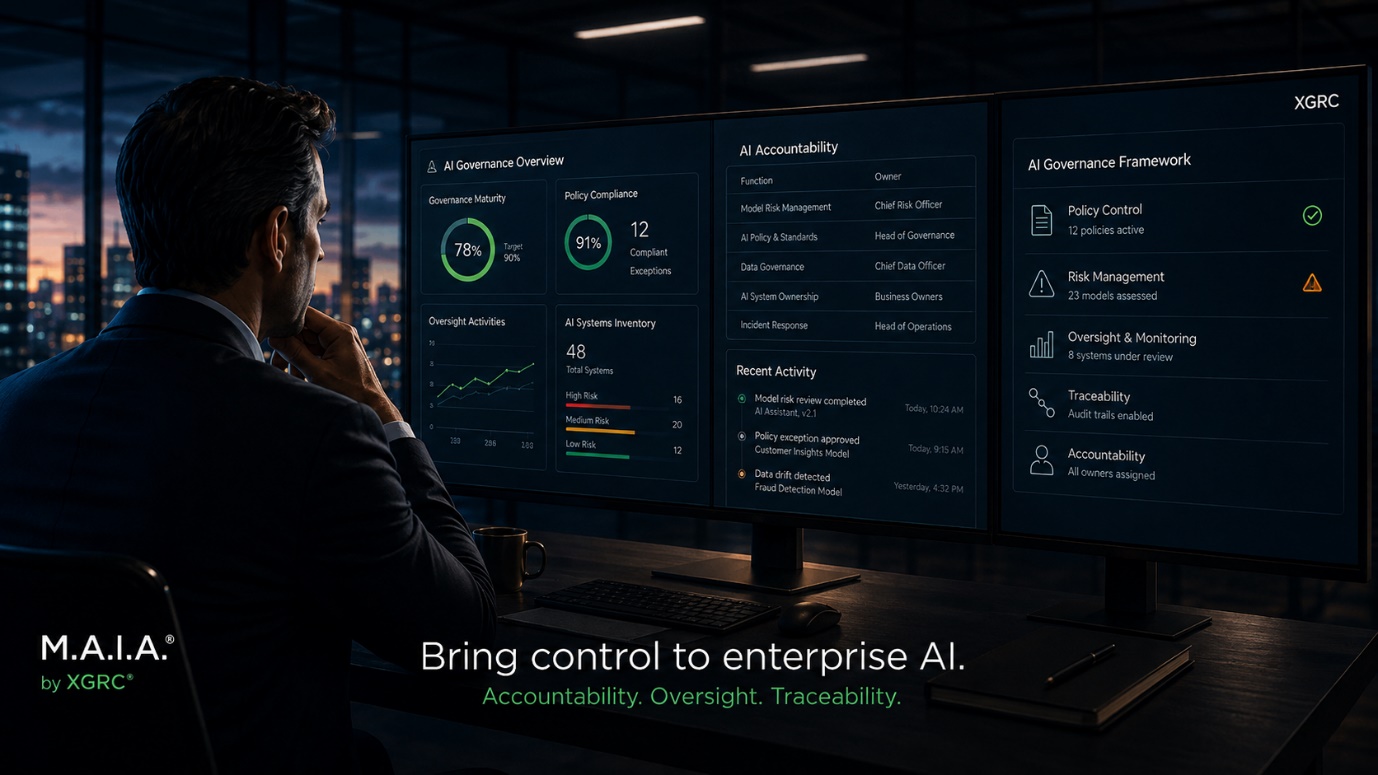
Most organisations did not choose to have an AI governance gap. It happened by default — employees started using ChatGPT and similar tools for real work faster than policies, permissions, or audit trails could catch up. In governance, risk and compliance functions specifically, that gap is dangerous: the data involved — risk registers, audit findings, policy content — is exactly the data an organisation cannot afford to expose, store externally, or use without an audit trail.
What Is Governed AI for GRC?
Governed AI for GRC is the controlled use of artificial intelligence to interrogate governance, risk, compliance, audit and policy data — within defined user permissions, security controls, and a complete audit trail of every interaction. It is not a separate AI product bolted onto existing governance tools. It is AI designed from the outset to operate inside the same boundaries, permissions, and accountability structures as the rest of the governance environment.
Governed AI vs Generic AI Tools
Generic AI tools are built for general-purpose use: broad access to whatever is pasted in, no persistent permission model, and typically no audit trail of what was asked or answered. Using them against governance data means an organisation cannot say with confidence who accessed what, whether the AI's output influenced a real compliance decision, or whether sensitive data left the organisation's control. Governed AI closes each of these gaps by design — access follows existing user permissions, every interaction is logged, and outputs are explainable rather than opaque.
When Organisations Need Governed AI
The need typically surfaces once governance data has grown too large and fragmented for manual analysis — a board member asks a residual-risk question that takes two days to answer, or an audit committee wants a real-time compliance summary that today requires pulling data from four disconnected systems. At that point, generic AI tools look tempting and are exactly the wrong answer, because the data at stake is the same data an ISO 27001 or POPIA audit would scrutinise.
Standards Context: ISO/IEC 42001
ISO/IEC 42001 is the first international standard for AI management systems, addressing exactly this governance gap — how organisations should manage AI risk, oversight and accountability. Organisations adopting AI in governance contexts should expect ISO/IEC 42001 alignment to become a due-diligence expectation, in the same way ISO 27001 is now for information security.
How MAIA® Delivers Governed AI
MAIA® is XGRC®'s governed AI for GRC — embedded within the platform so that AI interactions inherit existing user permissions, operate through controlled, audited AI integrations, and produce a complete interaction audit trail. Every question MAIA® answers draws only on data the requesting user is already authorised to see, and every interaction is logged for later review.
Governed AI is not about avoiding AI. It is about using it without creating the very governance risk it is meant to reduce. Organisations that get this right gain faster insight without accepting a new, ungoverned data risk in return.