
Being Compliant and Proving Compliance Are Not the Same Thing
Ask an organisation whether it is compliant, and the answer will often be yes. Ask it to prove that compliance immediately, and the conversation can become far more complicated: evidence has to be pulled from different departments, spreadsheets reviewed, emails searched for approvals, policies located, and responsible individuals asked to confirm whether actions were actually completed.
Demonstrable compliance means being able to show, at any moment, that every applicable obligation has been identified, assigned, actioned and backed by evidence, not simply that the underlying activities took place. This exposes an important distinction: knowing that compliance activities are taking place is not the same as having visibility of compliance.
As regulatory expectations increase and organisations become more complex, compliance can no longer rely solely on confidence that requirements are being addressed. Organisations increasingly need to demonstrate it.
Compliance Exists Across the Organisation
Compliance is rarely the responsibility of a single department. Modern organisations can face obligations arising from a wide range of sources, including:
- Legislation
- Regulations
- Industry requirements
- Contractual commitments
- Internal policies
- Management standards
- Customer requirements
- Organisational procedures
Responsibility for those obligations is often distributed throughout the business: finance may own some, HR others, and IT, SHEQ, legal, operations, sustainability and management may each carry different responsibilities of their own. This creates a significant coordination challenge.
Without a centralised view, management may struggle to determine whether every applicable obligation has been identified, assigned, addressed and supported by appropriate evidence.
The Hidden Challenge Is Often Evidence
Compliance is ultimately about more than completing an activity. An organisation may need to demonstrate that a requirement was understood, responsibility was assigned, appropriate action was taken and evidence exists to support the outcome. When evidence is distributed across departments, systems and individual employees, demonstrating compliance becomes significantly more difficult.
The problem often becomes visible when someone asks for proof: an auditor requests evidence, a regulator requires information, management wants an update, a customer asks about compliance, or a certification assessment begins. Suddenly, teams start searching: documents are requested, emails reviewed, evidence reconstructed, and employees asked to confirm what happened months earlier.
The organisation may have performed the required activities, but proving it becomes an administrative exercise. A more mature approach is to build evidence and traceability into the compliance process from the beginning.
Why Spreadsheets Alone Create Compliance Blind Spots
Spreadsheets remain useful business tools, but as compliance requirements grow, relying on multiple spreadsheets can make enterprise-wide oversight increasingly difficult. One department may maintain a legal register, another may track corrective actions, another may maintain policy reviews, and another may record supplier requirements. Each spreadsheet can provide useful information individually while still leaving management without a reliable view of the organisation's overall compliance position.
The challenge becomes greater whenever information changes, raising questions such as:
- Who owns the requirement?
- Has the obligation been reviewed?
- Is the evidence current?
- Is an action overdue?
- Has a control changed?
- Which version of the spreadsheet is correct?
The issue is not simply where compliance information is stored; it is whether management can obtain a reliable compliance position when it matters.
From Periodic Compliance to Continuous Visibility
Traditional compliance management can become heavily dependent on periodic reviews: information is collected before an audit, registers updated before management meetings, and evidence checked only as reporting deadlines approach. But compliance obligations do not disappear between reporting periods, and a more connected approach allows compliance information to stay continuously available for oversight.
Management can maintain visibility into:
- Applicable obligations
- Responsible owners
- Compliance status
- Supporting evidence
- Outstanding requirements
- Actions and due dates
- Areas requiring management attention
Instead of compliance information being assembled only when somebody requests it, it becomes part of the organisation's ongoing governance environment.
Better Compliance Visibility Strengthens Accountability
Compliance requirements need clear ownership; without it, obligations can easily become everyone's responsibility, and therefore nobody's.
A connected compliance environment makes it easier to establish:
- What must be done
- Who is responsible
- When it must be completed
- What evidence is required
- Whether the requirement has been addressed
- What remains outstanding
This gives management greater visibility while giving responsible individuals clearer expectations, and it also makes escalation easier. Instead of discovering overdue obligations during an audit or management review, organisations can identify areas requiring attention earlier, so compliance becomes more proactive rather than reactive.
Audit Readiness Should Be Continuous
For many organisations, audit preparation creates significant administrative pressure: teams collect documents, review registers, request evidence, investigate outstanding actions and manually confirm compliance status. This creates a familiar cycle where organisations prepare intensely for an audit and then return to normal operations once it is complete.
But true audit readiness should not begin when the auditor arrives. When obligations, responsibilities, actions and evidence are managed continuously, much of the information required for assurance already forms part of the governance record.
The organisation moves from preparing to demonstrate compliance toward already being able to demonstrate it, and that is an important difference.
Compliance Information Supports Better Management Decisions
Compliance visibility is not only valuable for compliance teams; it also gives management important information about organisational risk.
Leadership needs to understand:
- Where significant compliance gaps exist
- Which obligations require immediate attention
- Whether corrective actions are progressing
- Where accountability may be weak
- Which areas may create regulatory or operational exposure
- Whether controls and evidence support the organisation's compliance position
Without this information, leadership may make decisions based on an incomplete picture. With greater visibility, compliance information becomes part of broader organisational decision-making.
Technology Is Changing Compliance Management
As organisations grow, manual compliance management becomes increasingly difficult to scale: more regulations, more business units, more suppliers, more policies, more controls, more evidence, more responsible individuals and more reporting all add complexity at once. Adding additional spreadsheets or standalone systems may solve individual problems without solving the wider visibility challenge.
Modern compliance technology offers a more connected approach. It can help organisations to:
- Centralise compliance obligations
- Establish clear ownership
- Track compliance status
- Connect supporting evidence
- Monitor actions and due dates
- Improve reporting
- Strengthen accountability
- Improve audit readiness
- Identify compliance gaps earlier
- Support management oversight
The objective is not simply to digitise a compliance register; it is to create greater visibility across the compliance environment.
Creating a Single View With XGRC® Compliance Hub
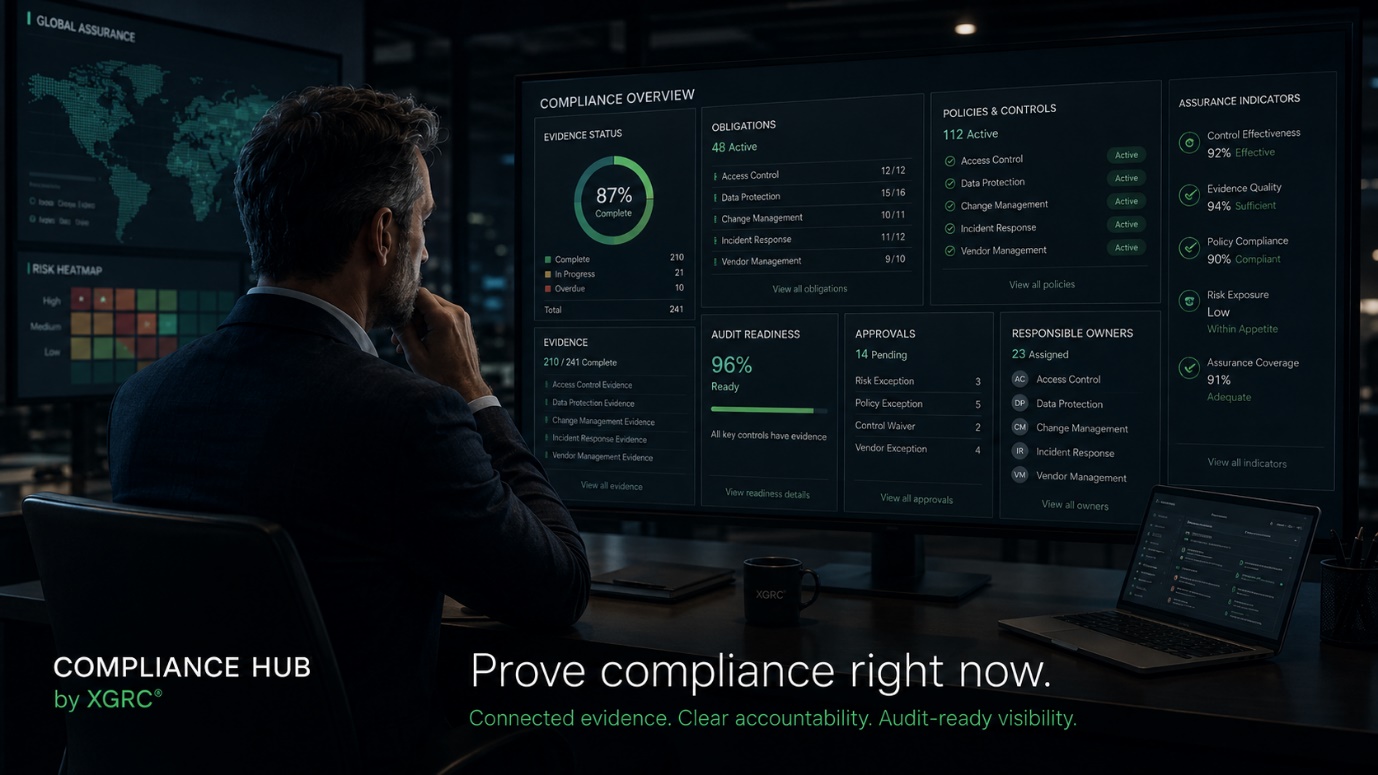
Compliance Hub by XGRC® provides a structured environment for managing compliance obligations, accountability, evidence and compliance status. Within the broader XGRC® Platform, organisations can create greater visibility across their compliance environment while maintaining the traceability required for effective governance.
Instead of compliance information remaining fragmented across individual departments and systems, organisations can create a more connected view of:
- Compliance obligations
- Responsible individuals
- Compliance status
- Supporting evidence
- Corrective actions
- Due dates
- Outstanding requirements
- Areas requiring management attention
This enables compliance to become more visible, structured and demonstrable.
Moving Beyond Static Compliance Registers With XLOGIC®
A compliance register tells an organisation what its obligations are, but governance must also ensure those obligations translate into action. Through XLOGIC® Executable Governance Architecture, governance requirements can move beyond static registers and connect with controlled workflows, responsibilities and organisational actions, strengthening the relationship between a requirement and its execution.
An obligation can have an owner, a requirement can trigger an action, an action can have a deadline, evidence can support its completion, and outstanding issues can receive management attention. Compliance becomes something the organisation actively manages rather than something it periodically checks.
Compliance Should Be Demonstrable
The question organisations should increasingly ask is not simply "Are we compliant?" It is "Can we demonstrate our compliance position, identify our gaps and show who is accountable for addressing them?" That is a higher standard.
It moves compliance away from assumption and toward evidence, from periodic reporting toward continuous visibility, from fragmented responsibility toward clear accountability, and from searching for evidence when somebody asks for it toward maintaining that evidence as part of everyday governance.
As regulatory complexity and stakeholder scrutiny increase, the ability to demonstrate control may become just as important as the control itself.
Can You Prove Your Compliance Position Today?
Compliance should not become visible only when an auditor, regulator or executive asks for evidence. Organisations need the ability to understand their compliance position continuously, and Compliance Hub by XGRC® helps them centralise obligations, establish accountability, connect evidence and actions, and create greater visibility across the compliance environment.
Speak to an XGRC® specialist to discover how Compliance Hub can help your organisation move from assumed compliance to demonstrable compliance.