
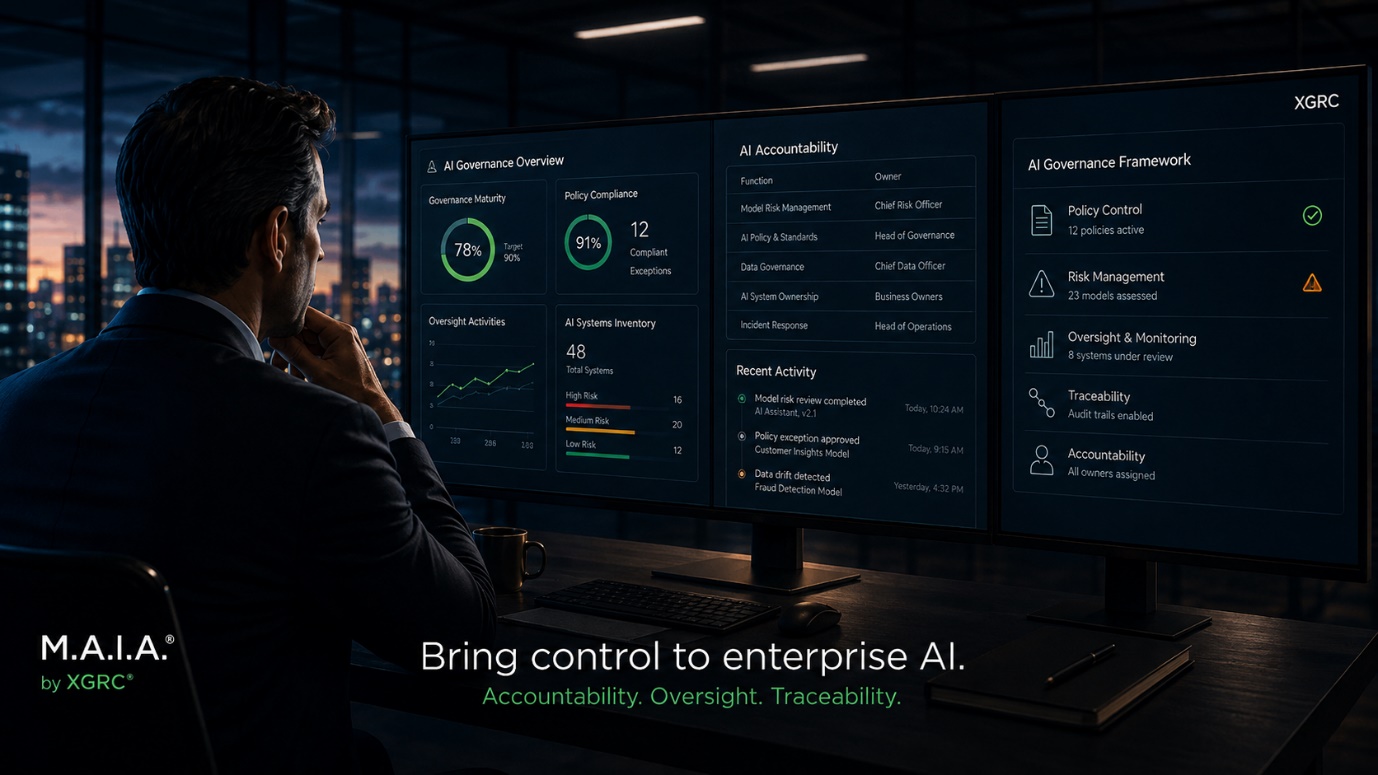
AI Adoption Is Moving Faster Than Governance
Artificial intelligence is entering organisations at extraordinary speed. Employees are using it to research information, analyse data, create content, summarise documents, draft policies and support decisions, while organisations are also beginning to weave AI into workflows, customer experiences and operational processes.
The AI governance gap is the growing distance between how quickly organisations adopt artificial intelligence and how slowly the accountability, oversight and audit trails needed to control it actually get built out.
But a critical question is emerging: is organisational governance evolving as quickly as AI adoption? For many organisations, the answer may be no, and that gap is quickly becoming one of the most important governance challenges of the next decade.
Adoption Is Easy. Governance Is Harder.
Access to powerful AI capabilities has become remarkably simple, but governance has not kept pace. Once AI begins influencing organisational activity, difficult questions start to surface.
- Who is accountable for an AI-supported decision?
- What information was provided to the AI?
- How is sensitive organisational information protected?
- What controls apply to AI-enabled processes?
- When should a human review or approve an output?
- How is AI usage monitored?
- Can AI activity be audited?
These are not simply technology questions, they are governance questions. As AI becomes embedded deeper into everyday work, organisations need reliable answers to all of them.
The Problem With Invisible AI
One of the greatest AI governance challenges may not be the systems an organisation officially approves, but the AI usage that management cannot see. Employees can begin using publicly available AI tools within minutes: a document summarised, a report drafted, a risk assessment analysed, business information entered into an AI platform, a decision shaped by an AI-generated recommendation, often before any formal governance structure has been established.
As adoption expands, organisations can find themselves with a growing gap between what AI is capable of doing and what the organisation is capable of governing. This creates an important visibility challenge: organisations cannot effectively govern AI activity they cannot see.
Policies Alone May Not Be Enough
Many organisations respond to AI risk by developing an AI policy, and that matters. But a policy alone does not guarantee controlled AI usage. It may explain which tools employees can use, define acceptable behaviour, establish restrictions around sensitive information and require human oversight, yet organisations still need mechanisms to translate those requirements into everyday behaviour.
- Who has access?
- What activities are permitted?
- How is usage monitored?
- Where is accountability established?
- What happens when a requirement is breached?
- How can management demonstrate that governance requirements are actually being followed?
Effective AI governance therefore requires more than documented rules. Governance needs to become part of how AI is actually used.
Why AI Accountability Matters
AI can support a decision, but responsibility for that decision still needs to exist somewhere within the organisation. This becomes particularly important as AI moves into higher-impact business processes.
- If an AI-generated recommendation contributes to a risk assessment, who validates it?
- If AI assists with a policy, who approves the final document?
- If AI summarises compliance information, who verifies its accuracy?
- If an AI-supported process produces an incorrect outcome, who is accountable?
Responsible enterprise AI requires organisations to maintain clear human accountability. AI may support organisational activity, but it should not make responsibility disappear.
AI Governance Requires Visibility
Strong governance depends on visibility. Management needs to understand where AI is being used, how it is being used and what governance requirements apply, including visibility into:
- AI access
- User activity
- Approved use cases
- Organisational responsibilities
- AI interactions
- Usage patterns
- Governance controls
- Human oversight
- Compliance requirements
- Audit information
Without this visibility, organisations may struggle to determine whether AI usage remains within acceptable governance boundaries. Visibility therefore becomes a foundation for accountability.
AI Governance Requires Traceability
Another important consideration is traceability. Traditional governance processes depend heavily on records: organisations document decisions, maintain evidence, record approvals, track actions and retain audit trails. AI should not exist outside these expectations.
Where AI contributes to organisational processes, organisations increasingly need to understand how that activity fits into the wider governance record. This becomes particularly important for internal assurance, management oversight and audit readiness. The question should not simply be whether AI was used, but how it was used, by whom, and within what governance process.
Human Oversight Remains Essential
AI can process information quickly, assist with analysis, generate content, identify patterns and support employees in completing complex tasks. But enterprise governance still requires judgement, and human oversight helps organisations determine whether AI-generated information is appropriate, accurate and suitable for the intended business context.
The level of oversight may vary depending on the activity. Low-risk administrative assistance may require relatively limited intervention, while higher-impact activities involving risk, compliance, policy or organisational decisions may require stronger review and approval. The objective is not to remove human involvement, but to determine where human accountability needs to remain within AI-supported processes.
Governance Must Be Built Into the Process
Responsible enterprise AI requires structure. Organisations need mechanisms for defining accountability, controlling access, maintaining traceability, managing information and introducing appropriate human oversight. This does not mean preventing employees from benefiting from AI, quite the opposite: the objective should be to enable innovation within clearly defined governance boundaries.
That is where governed AI differs from simply providing access to an AI tool. One provides capability. The other provides capability within control.
Technology Is Changing AI Governance
As enterprise AI adoption grows, manual oversight becomes increasingly difficult, with more users, more interactions, more use cases, more information, more AI-supported workflows and more governance considerations to manage at once. Organisations therefore need to think beyond simply approving individual AI applications.
Modern AI governance requires mechanisms that can help organisations:
- Establish controlled access
- Maintain accountability
- Monitor AI usage
- Support human oversight
- Improve traceability
- Strengthen transparency
- Maintain governance records
- Support auditability
- Understand AI activity across the organisation
AI governance needs to evolve alongside AI capability.
M.A.I.A.® and Governed Enterprise Intelligence
M.A.I.A.® represents XGRC®'s approach to bringing artificial intelligence into a governed enterprise environment. Rather than separating AI from governance, M.A.I.A.® is designed around the principle that intelligence should operate within structured organisational controls.
This changes the conversation around enterprise AI. Instead of asking only what AI can do, organisations can begin considering how AI can operate within existing governance expectations, with the focus shifting toward controlled, accountable and traceable AI adoption.
Connecting AI With Executable Governance
Governance becomes more effective when requirements translate into organisational processes. Combined with the XGRC® Platform and XLOGIC® Executable Governance Architecture, the M.A.I.A.® approach supports the broader objective of making AI activity more controlled, accountable and traceable.
This matters because AI governance should not exist separately from organisational governance: policies need responsibilities, responsibilities need controls, controls need oversight, actions need accountability, and governance activities need traceability. Bringing AI into that environment allows organisations to treat intelligence as part of the governance architecture rather than as an external tool operating beyond it.
Moving From AI Capability to Governed AI
The first stage of enterprise AI adoption often focuses on capability: what can AI automate, what can it analyse, how much time can it save, which processes can it improve. Those questions remain important, but mature AI adoption introduces another set of questions entirely.
- Can we control it?
- Can we monitor it?
- Can we demonstrate accountability?
- Can we maintain appropriate human oversight?
- Can we trace AI activity?
- Can we demonstrate responsible usage?
The enterprise AI conversation therefore begins to shift, from simply asking what AI can do to asking how AI can operate responsibly within the way our organisation is governed.
The Next AI Advantage May Be Trust
AI capability itself is becoming commoditised, so access to AI alone is unlikely to remain a differentiator for long. What is likely to matter more is how quickly an organisation can close its own governance gap, because the ability to deploy AI responsibly depends on it.
Customers may want confidence, executives may want oversight, compliance teams may want traceability, risk teams may want controls, auditors may want evidence, and employees may want clarity, and none of that can be supplied by adoption speed alone.
Trust will not come from simply saying AI is governed. It will come from being able to demonstrate it, and that demonstration is exactly what a closed governance gap looks like.
The Future of AI Is Governed
Artificial intelligence will continue to evolve. Its capabilities will become more sophisticated, its use across organisations will increase, and its influence on everyday business processes will become more significant. Governance must evolve alongside it.
The organisations best positioned for the next phase of AI adoption may not necessarily be those deploying the most AI tools. They may be those that establish the strongest foundations for responsible adoption:
- Clear accountability
- Controlled access
- Appropriate human oversight
- Traceability
- Visibility
- Auditability
Because the organisations that benefit most from AI may not be those that adopt it fastest. They may be the organisations that learn how to govern it best.
Close the AI Governance Gap
AI adoption should not require organisations to choose between innovation and control. The opportunity is to enable both. M.A.I.A.® by XGRC® Software brings artificial intelligence into a governed enterprise environment designed around accountability, control and traceability.
Combined with the XGRC® Platform and XLOGIC® Executable Governance Architecture, organisations can begin moving from simply adopting AI toward governing how AI operates within the enterprise. Speak to an XGRC® specialist to discover how M.A.I.A.® can help your organisation build a stronger foundation for governed enterprise AI.